
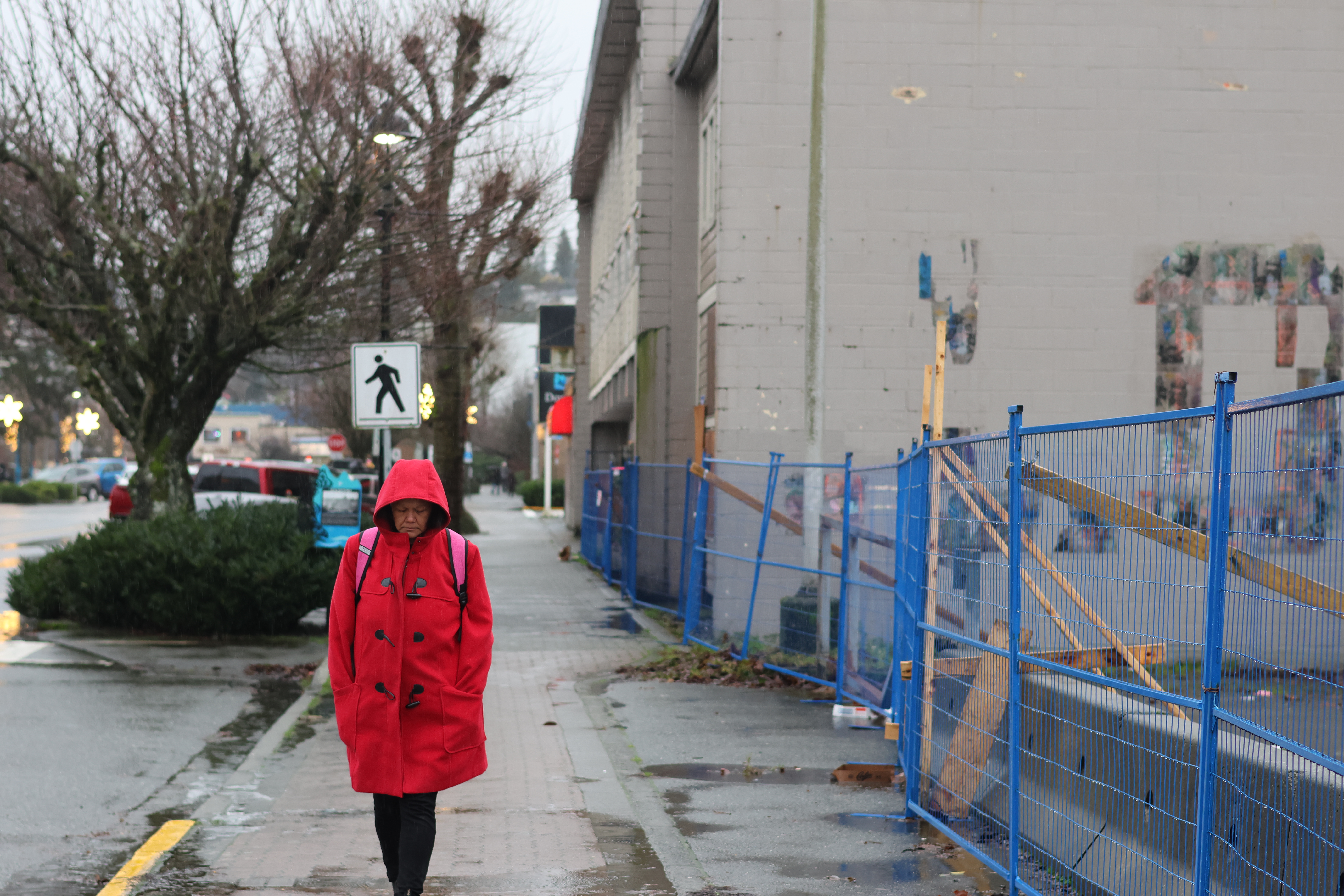
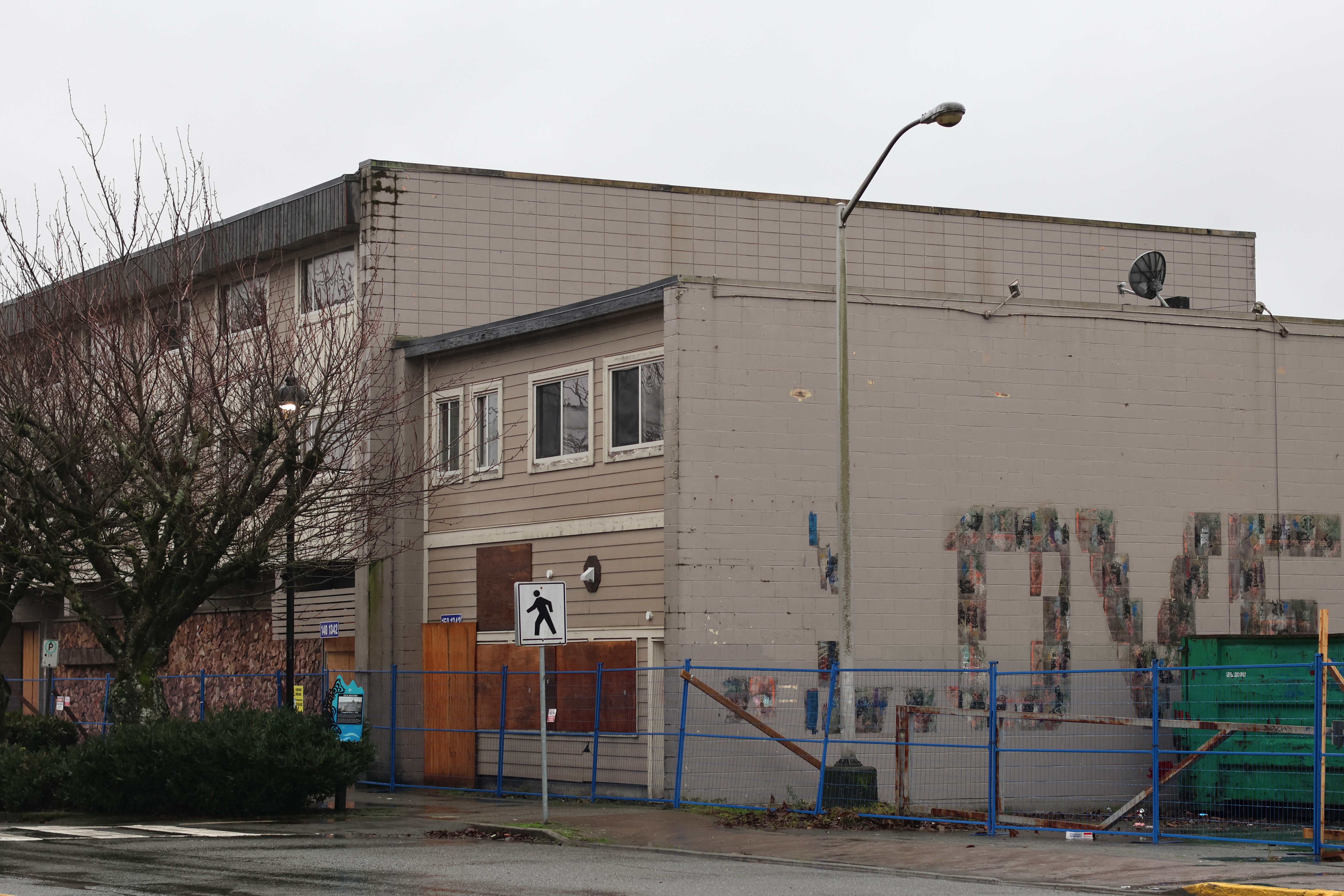
Campbell River’s Berwick by the Sea retirement community is lit up with holiday flair, while across the street a mural portraying the word L-O-V-E fades on the side of boarded up building that was once a lifeline for the homeless.
Six months ago, at the end of June 2025, Kwesa Place and Hem’?aelas Community Kitchen were forced to close after the City of Campbell River bought the properties for redevelopment.
Kwesa Place and Hem’?aelas Kitchen first opened its doors during pandemic times. Kwesa, which means ‘a place of welcome’, offered laundry, shower, clothes, coffee and snacks, seven days a week. Hem’?aelas, which translates to ‘a place to eat’, provided a hearty dinner every night to at least 50 souls.
Both organizations were operated by the Laichwiltach Family Life Society (LFLS), a multi-service community hub that primarily supports Aboriginal children and families in the Campbell River area.
LFLS executive director Audrey Wilson said the society helped residents of the Pacific West low-income apartments after a fire tore through the building in April 2020, leaving 86 people homeless.
“My staff were resilient and nobody got sick, thank God. We had clothes and everything donated for those people [who] lost everything,” he said.
Located on the east coast of Vancouver Island about 220 kilometres north of Victoria, Campbell River resides on the unceded territory of the We Wai Kai, Wei Wai Kum and Kwiakah First Nations. Just east of Strathcona Provincial Park, the city sits at the gateway for the northern region Nuu-chah-nulth Nations of Ehattesaht, Ka:'yu:'k't'h'/Che:k'tles7et'h', Mowachaht/Muchalaht and Nuchatlaht.
On April 30, 2025 the Homelessness Services Association of BC (HSABC) conducted a 24-hour Point-in-Time count, which identified 174 people who were experiencing homelessness in Campbell River. Of those 174 people, 125 - or 72 per cent - were “unsheltered”, which HSABC describes as “staying outside in alleys, doorways, parkades, parks and vehicles or staying temporarily at someone else’s place”.
Fifty-eight per cent of the 174 respondents identified as Indigenous, according to HSABC.
HSABC states that: “Disproportionate rates of homelessness are rooted in the ongoing structural violence of settler colonial society that creates hierarchical systems of privilege and oppression. Indigenous people in Canada face racism, discrimination, and the impacts of intergenerational trauma which can limit safe and equitable access to services making it easier to lose, and harder to acquire, safe and stable housing.”
Neither Kwesa Place nor Hem’?aelas Kitchen have been successful in their search for a new location. Wilson says new city zoning bylaws – and resistance from landlords – are making it a real challenge.
“It’s so hard when you get told, ‘We don’t want your type of service in our buildings’. It’s very disappointing. I thought we were passed that. They are people too. That’s what people seem to forget,” said Wilson.
Meanwhile at Berwick’s senior living complex in Campbell River, studio suites start at $3,400 a month for 329 to 470 square feet, and one-bedroom units go for $4,250.
In effort to improve public safety in Campbell River’s downtown, the city adopted new zoning bylaws in 2024 that prohibit the use of social care facilities, overdose prevention sites, escort services, massage parlors. The city also passed bylaws that discourage automobile-oriented businesses in the downtown area east of Dogwood Street, such as motels, gas stations, vehicle sales or car rental shops. The only permitted social services east of Dogwood are acquired injury clinics, child care facilities, a community living facility, extended care residences and hospice.
“Until the bylaws change, we are going to be restricted as to where we can go. That has been proven over and over,” said Wilson.
The city also sent a cease-and-desist letter to CRASH Harm Reduction in October for a meal distribution program in the downtown core. The letter cited “Public Nuisance Bylaw No. 3543, 2014” and threatened fines and/or other legal proceedings if the organization did not comply.
Sue Moen works on the front lines with Campbell River’s most vulnerable residents. She is a Kwesa volunteer and coordinates the Campbell River Community Action Team, a network that responds to the toxic drug poisoning crisis.
“It doesn’t matter what (the city) does,” she said. “We will feed people and we will keep feeding people. You cannot criminalize or punish us for feeding people.”
The city says the letter was issued because the group was operating without a permit.
“As it is a public space, all users of Spirit Square must request a permit in advance and adhere to conditions of use,” the city said in an email. “Following these events, staff observed a number of safety concerns, including accumulation of garbage, public drinking and open drug use, and other incidents which reinforced the need for proper oversight.”
It’s hard to know whether or not the closure of Kwesa Place has impacted Campbell River’s high rate of overdose deaths, notes Moen.
“But what there isn’t is the opportunity to develop deep, meaningful long-term connections in the same way that you can when there is a place,” she said.
“Where we are now is people are traumatized, they are pain, they are cold, they are wet, they are brutalized both verbally and physically,” continued Moen. “They have nowhere to sleep. They are all sleep deprived. It would be totally unreasonable to even offer sobriety to those people because they wouldn’t. They would not have the ability or capacity to make an informed choice because they are just coping. They are coping and the substances are their coping mechanisms.”
As of August this year, data from the B.C. Coroners Service shows Campbell River with the highest rate of fatal overdoses on Vancouver Island, a local health are that ranks fifth in the province with 65.2 deaths per 100,000 residents. In 2024 this rate was 120 per 100,000, a year that saw paramedics respond to 952 calls in Campbell River for overdoses and drug poisonings.
At the same time, RCMP crime statistics for January to November 2024 show property crime in the downtown dropped by 37.8 per cent, while violent crime in the area fell by 28.9 per cent.
These numbers show that the city’s efforts are working, says Mayor Kermit Dahl.
“A healthy and safe community has always been our top priority,” he said in a media release. “We listened to residents and businesses, took action to improve downtown safety, and invested in resources for RCMP, Bylaw and security, cleanliness programs, and supportive housing. These results—lower crime rates and fewer calls—show we’re on the right path, and we’ll keep building on this progress.”
‘Birth is a lottery when you think about it’
When Hem’?aelas Kitchen was up and running, the Campbell River (CR) Food Bank was the source of most of their supplies, according to CR Food Bank manager Sandra Rushton.
“Now with money being so tight, we haven’t been able to do that,” said Rushton, adding that they serve many other agencies in the region and are in conversation with local First Nations to see how they can continue to work together.
“Without community support we wouldn’t last,” she said.
The CR Food Bank currently feeds 1,300 people a month with 30 per cent of their clients being seniors living on pensions. They had a net increase of 92 new people sign up in October.
“There is no middle class anymore because of the cost of living,” said Rushton. “Birth is a lottery when you think about it.”
The city set-up temporary services to support Laichwiltach as they search for a new home and say they will work with them on zoning compliance for any proposed relocation sites, and will even expedite applications if needed.
The interim services, which are noted to expire at the end of February 2026, include takeaway dinners available through the Salvation Army Centre of Hope and free showers, laundry and hygiene supplies at the Campbell River Community Centre.
But Moen says the community centre is “not a very welcoming space or safe space” for the homeless, who often face stigma and discrimination from other patrons. At Kwesa, Moen shared that people were treated with “love and dignity”.
“You can see the horrible deterioration of their physical health since the kitchen and Kwesa closed. People have lost weight. They are not able any longer to take care of their stuff. So many people have foot issues right now because they have trench foot just from constantly being wet and have nowhere to dry off. They are moved along all the time,” she told the Ha-Shilth-Sa.
The community centre also acts as an emergency warming centre, operated by the city when Environment Canada forecasts temperatures of -4°C or lower, or with a forecast low of 0°C or colder within 24 hours of a weather warning.
Jeff Ford, Campbell River’s director of community safety, says the warming centre was operated 29 nights last winter with roughly 30 to 50 visitors each evening
“It’s a safe space for people experiencing homelessness to sit down have a bite to eat, have a hot drink and warm up,” said Ford, adding that there are experienced contractors working with unhoused people on the site.
“Our firefighters also go around and do wellness checks on the streets during cold weather events,” said Ford.
He brought up Homewood, a temporary housing initiative for low income or no income residents.
“The city is committed to a housing-first model, demonstrated through projects like Homewood, which provides housing and on-site supports such as food and hygiene services,” said Ford. “Homewood currently houses 40 residents with integrated supports, and this number will soon increase to 48.”
In the meantime, Laichwiltach has converted an old food truck into an outreach vehicle, which is ready to hit the streets during the Christmas break. Kwesa’s mobile outreach team will offer sleeping bags, tents, tarps and whatever else is needed.
“We will move around. We won’t stay in one place,” said Wilson.
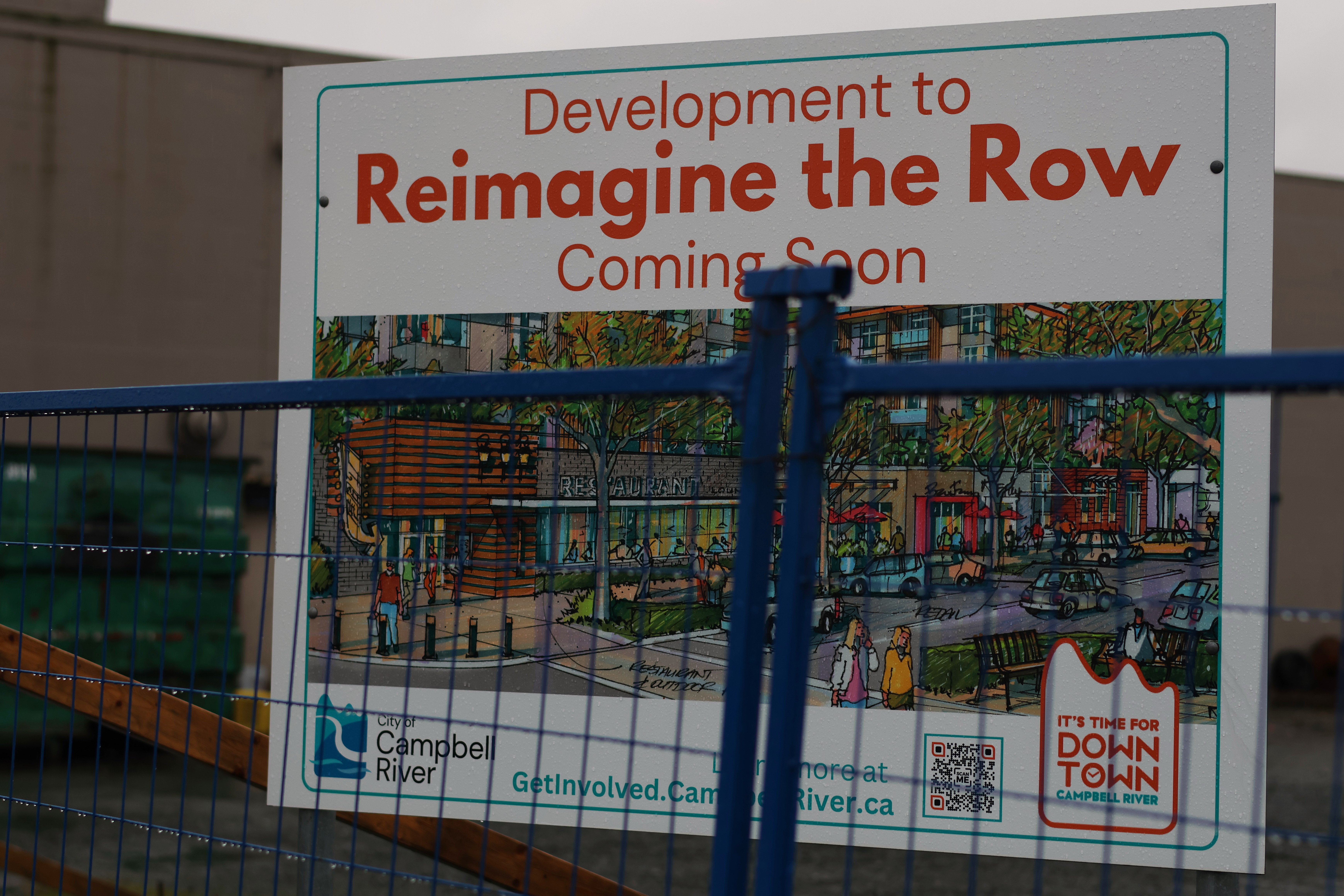
Demolition of the old 1300-block of Shoppers Row is slated for early 2026 and development plans include up to 200 residential rental units, as well as commercial and civic spaces.


