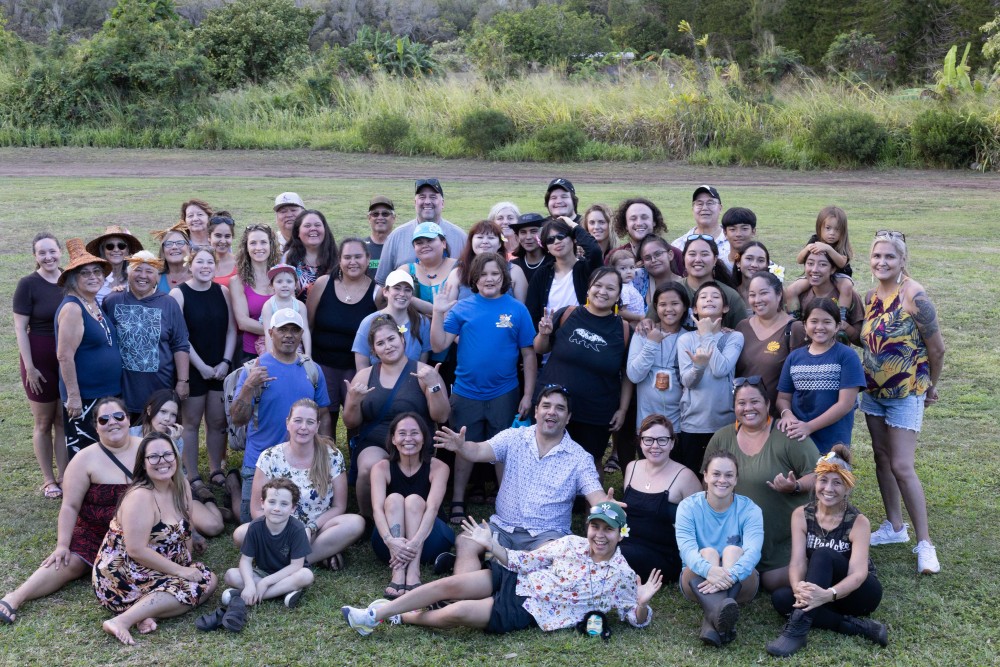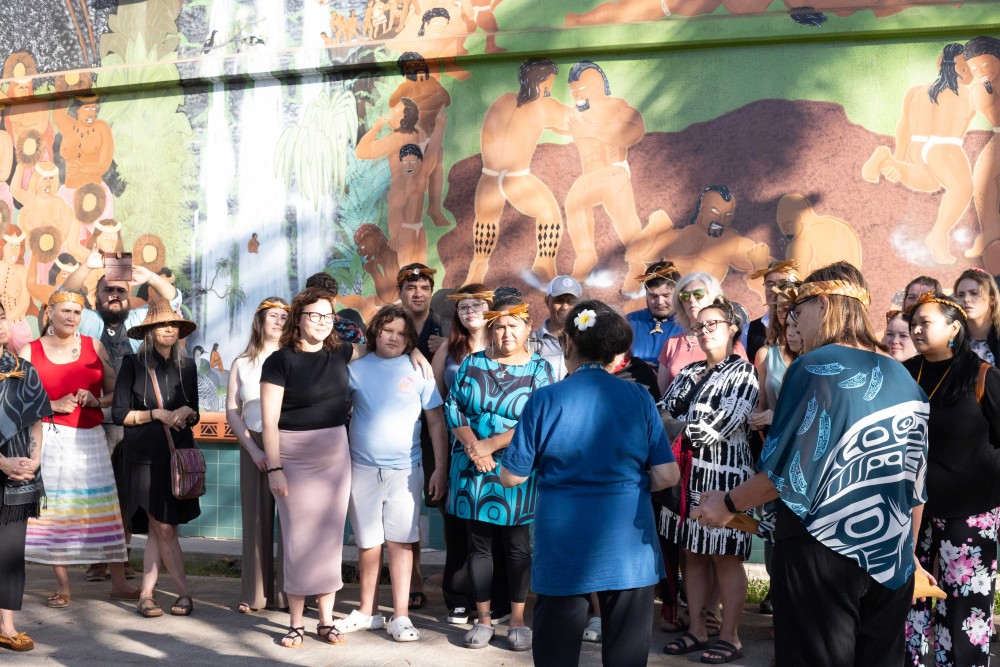
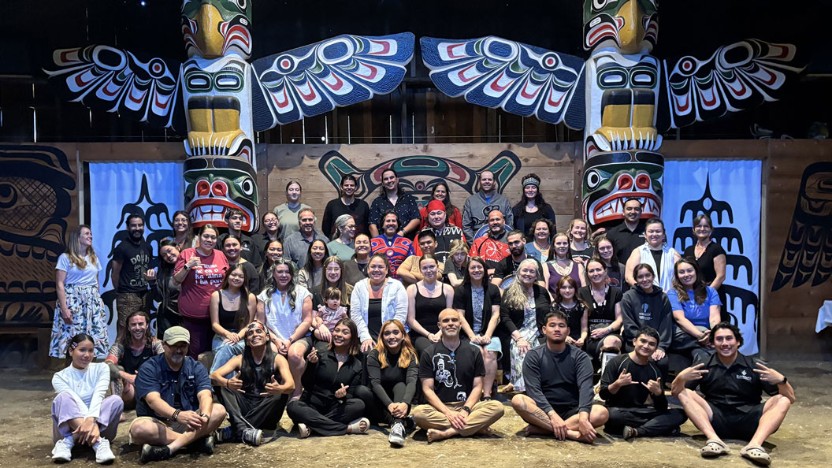
North Island College recently hosted its first-ever cohort of international field school students from Hawaiʻi, Aotearoa (New Zealand) and Mexico.
From May 25 to June 5, a group of 17 Indigenous students and their teachers from colleges and universities located around the Pacific Ocean were in the region to engage in various educational and cultural activities. The trip was the latest exchange as part of NIC’s international Indigenous field school program.
Kelly Shopland, NIC’s executive director of Indigenous Education, says the field school is part of the college’s “approach on the indigenization of international education” which began in 2021.
“So the Indigenous Education department was consulted, and we decided to do a completely Indigenous-led international field school, which was very different from prior NIC international field schools,” said Yawač, Ian Caplette, an Indigenous education instructor at NIC’s Port Alberni campus. “We created it, it wasn’t based on any model.”
With support from the office of Global Engagement to liaise with the international institutions, NIC established relationships with several colleges and universities around the Pacific, including in Hawaiʻi, Aotearoa (New Zealand), Mexico, Costa Rica, and Japan.
In 2022, a group of Indigenous NIC students travelled to Hawaiʻi. In 2024, another cohort of NIC students visited New Zealand, followed by a return trip to Hawaiʻi in 2025.
“Almost 90 Indigenous NIC students have been involved in the program over the course of the last four to five years,” said Shopland.
As Caplette explained, the students have to undertake a lot to be part of the field school.
“They have to get their passports, do the admin work, plus they have to be successful in school,” he said. “So it's not a vacation, it’s a learning opportunity.”
Travelling abroad was often “transformative” for the NIC students, said Shopland.
“For some it was their first time on a plane, or their first time leaving the island, or their first time leaving their communities,” she said. “The learners came from a variety of backgrounds, but one of our key messages is that we’re not separated but connected by the Pacific. These were amazing cultural exchanges, which the students then shared back with their home communities.”
Another key message for the students in the field schools was about how to make the exchange grounded in Indigenous ways of being.
“How do we show up in another Nation's territory?” said Caplette. “How do we do so in a respectful way? This was a learning process for us, but we followed the host’s own welcome protocols and we also practiced our own, and it worked really well.”
The program is also rooted in reciprocation, said Shopland. So, in 2026, after several successful trips abroad, “it was our time to host. We reached out to the colleges who had hosted us, and with the new Indigenous student housing at the NIC Courtenay campus, the stars started to align.”
Students from four institutions visited the region on the latest field school, including the University of Hawai‘i’s Maui and Kapiʻolani Colleges, the University of Waikato in Aotearoa (New Zealand), and the University of Colima in Mexico.
One of the Colima students on the recent trip was Ana Paula Ruiz Arce, a 22-year-old Mexican journalism student.
“It was my first time in Canada and I was so impressed, you guys are so humble and nice to tourists like me,” said Ruiz Arce.
But this wasn’t her first contact with NIC.
“Since 2022 I have been part of an online journal project,” she added. “This was something more intimate than just a school project. We shared our culture, pictures, songs, and stories. We realised we had a lot of stuff in common.”
The group’s 10-day trip started in K'ómoks territory - and straight away hit a slight hiccup.
“We had to adjust to not canoeing in the harbour, because of the unfortunate recent sewage incident,” Shopland said. “With K'ómoks First Nation’s support, they trailered out their canoe, and another canoe came down from Kwakiutl First Nation up in Fort Rupert, and another canoe came up from Qualicum, so we were able to have three traditional canoes out on Comox Lake. That was fabulous, and not something you see everyday.”
Group welcomed by Nuu-chah-nulth nations
Next, the group was off to Nuu-chah-nulth territory for community visits to c̓išaaʔatḥ, Tla-o-qui-aht and Yuułuʔiłʔatḥ First Nations.
“When we arrived in Port Alberni, we were welcomed by the c̓išaaʔatḥ hereditary chief and elected chief at Somass Hall,” said Caplette. “We shared our histories, including pre-European contact, when there was contact between our tribes across the ocean. Then we went down to the river where our hosts told us about its history and sacred importance to c̓išaaʔatḥ, and how they are maintaining the health of the river and the salmon.”
The next day, the group travelled to the west coast to meet with mułaa Rising Tide, an Indigenous and community-led surfing initiative, for a dinner and surfing lesson.
“I was really nervous to surf, because I never surfed in my life,” said Ruiz Arce. “And it was my first time swimming in really cold water. But it was really connecting. I believe a lot in Mother Nature, so I always ask the sea if I can swim, I always ask for permission, and thank Mother Nature for letting me be here with them.”
In Tofino, the group stayed at the Tin Wis Resort as guests of Tla-o-qui-aht First Nation, whose hospitality was amazing, said Ruiz Arce, who got to try oolichan grease.
“Actually I didn't have a lot of salmon in my life until I came to B.C. I also tried something, some kind of oil, it tasted like a fishy strong flavour. It was a whole experience,” she said.
For their last day on the west coast, the group visited Yuułuʔiłʔatḥ for a tour of their museum and long house, and for more sharing of stories, songs, dances, and food.
“Our friends from Aotearoa shared a haka with the elders,” said Caplette. “The elders were so pleased to see it, and they taught the haka to everyone assembled who could get up and dance. It was a lot of fun, and after that the Hawaiians taught us hula.”
Back on the east coast, the last trip for the group was with Homalco Wildlife and Cultural Tours to Bute Inlet.
For Shopland, it’s important to highlight the support of the Nations - K'ómoks, c̓išaaʔatḥ, Tla-o-qui-aht, Yuułuʔiłʔatḥ, Kwagu'ł, Wei Wai Kum, We Wai Kai and Homalco - who hosted or supported activities for this trip.
“NIC was the facilitator, but the learning happened in community. The generosity of the Nations, the time, how many members would come out to participate, was pretty phenomenal,” she said.
For Ruiz Arce, the experience has been life changing.
“Before coming to Canada, I had a very general understanding of Indigenous people. In Mexico, the government really doesn't support Indigenous people,” reflected Ruiz Arce, who learned about the historically problematic relationship First Nations have had with Canada, but also recent efforts for cultural revitalization. “In Mexico, we need that. We need our people to be proud for who they are. So one thing that really stood out to me was the importance of cultural revitalization. I learned about efforts to preserve language, traditional and knowledge for future generations, and I found that really inspiring. I also took away from the experience the importance of listening to communities tell their own stories. As a future journalist, this is something I will carry with me.”
Funding discontinued
But despite such positive experiences, the future of the NIC international Indigenous field school is uncertain. The federal funding that allowed students to participate in the program at no cost was discontinued in March 2025. At present, NIC does not have plans or funding to support future international Indigenous field schools.
“So we have to become more creative,” said Caplette.
“The office of Global Engagement is always keeping an eye out for grants and proposals,” said Shopland. “There’s always new opportunities coming up, but they’re often one-offs.”
Many of the students are brought to tears, said Ian Caplette, when they think about how impactful this program has been on their lives.
“Those are gifts you can’t put money on, you can't replicate that in a vacation package, you can only experience that through these types of opportunities,” he said. “To say that we’re connected allows us strength [in] how you feel about your place in this world, especially when we’re recovering from a lot of the challenges that have been placed upon us. It’s a way to strengthen our identities, and our resolve to overcome colonization.”