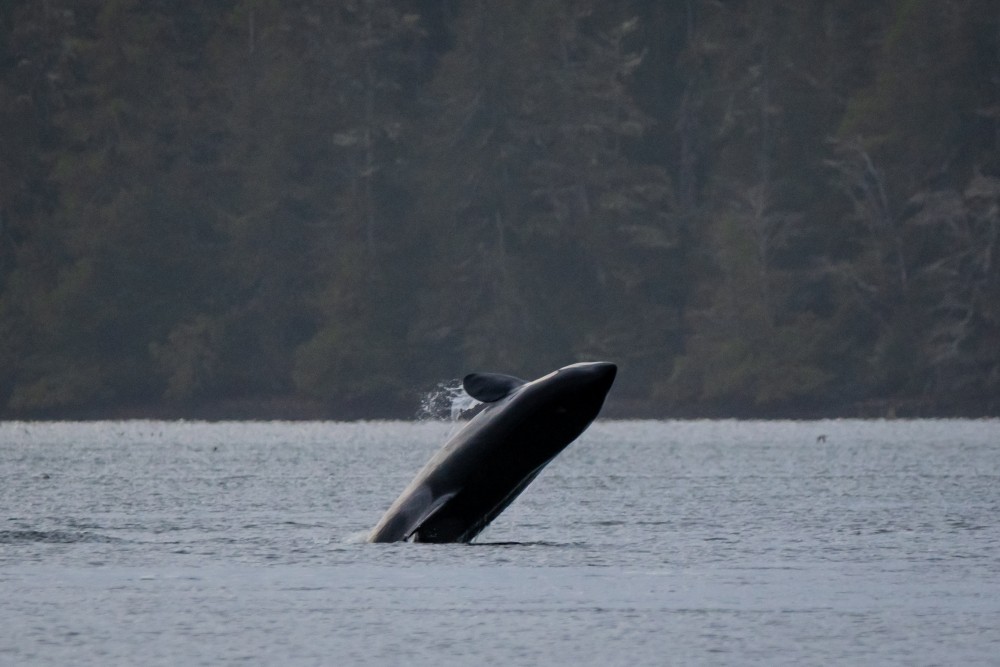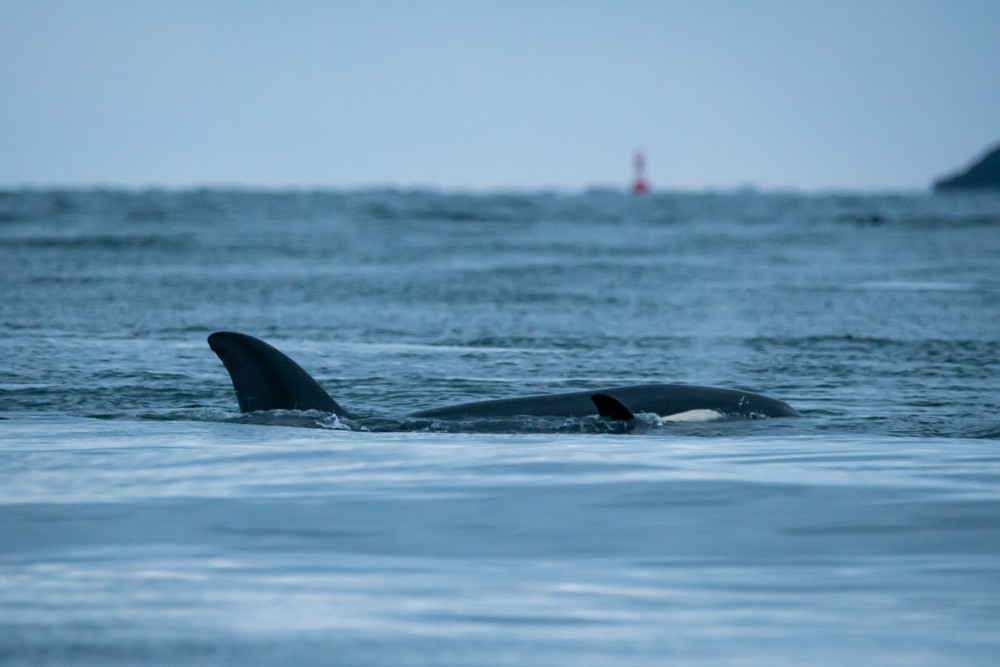
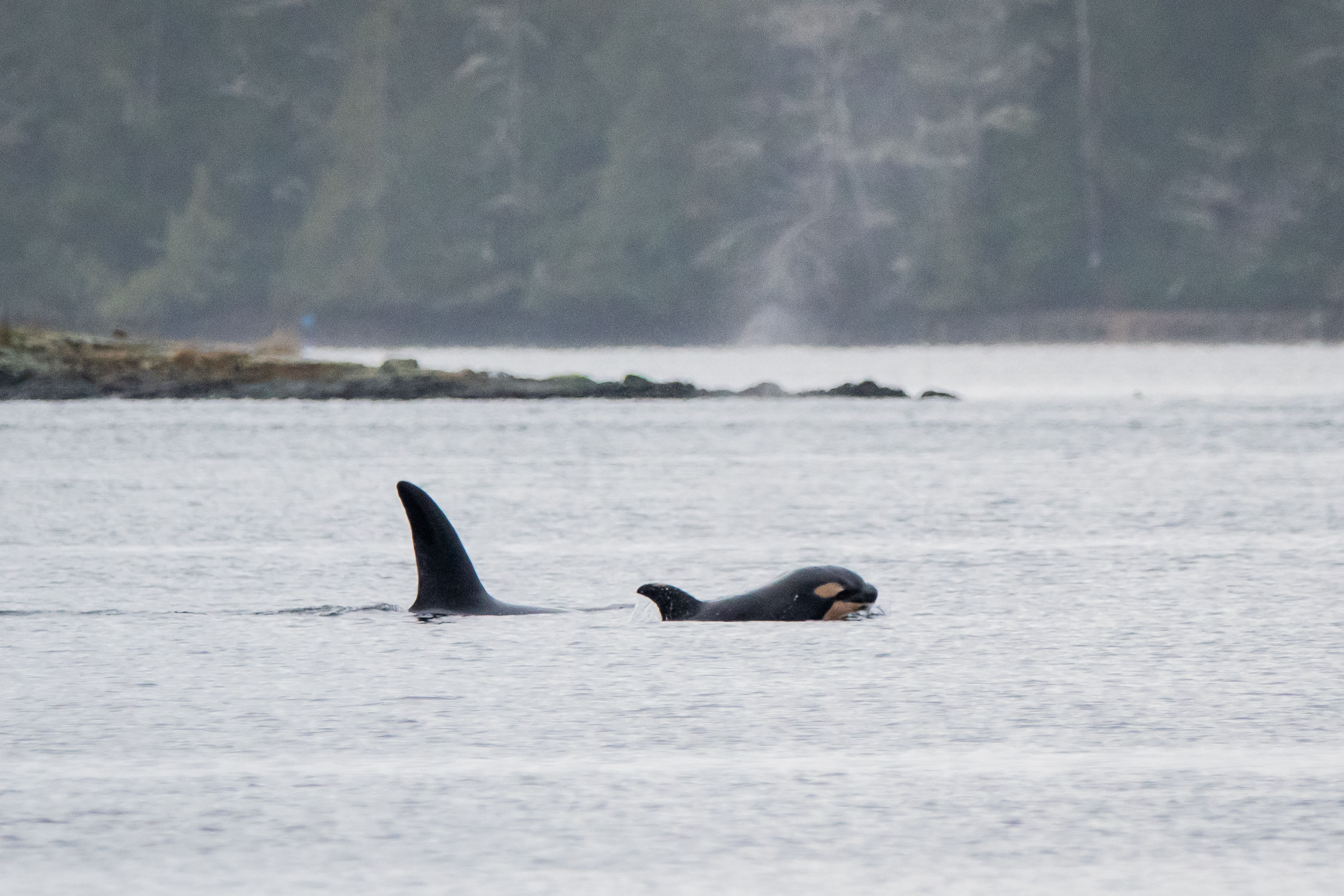
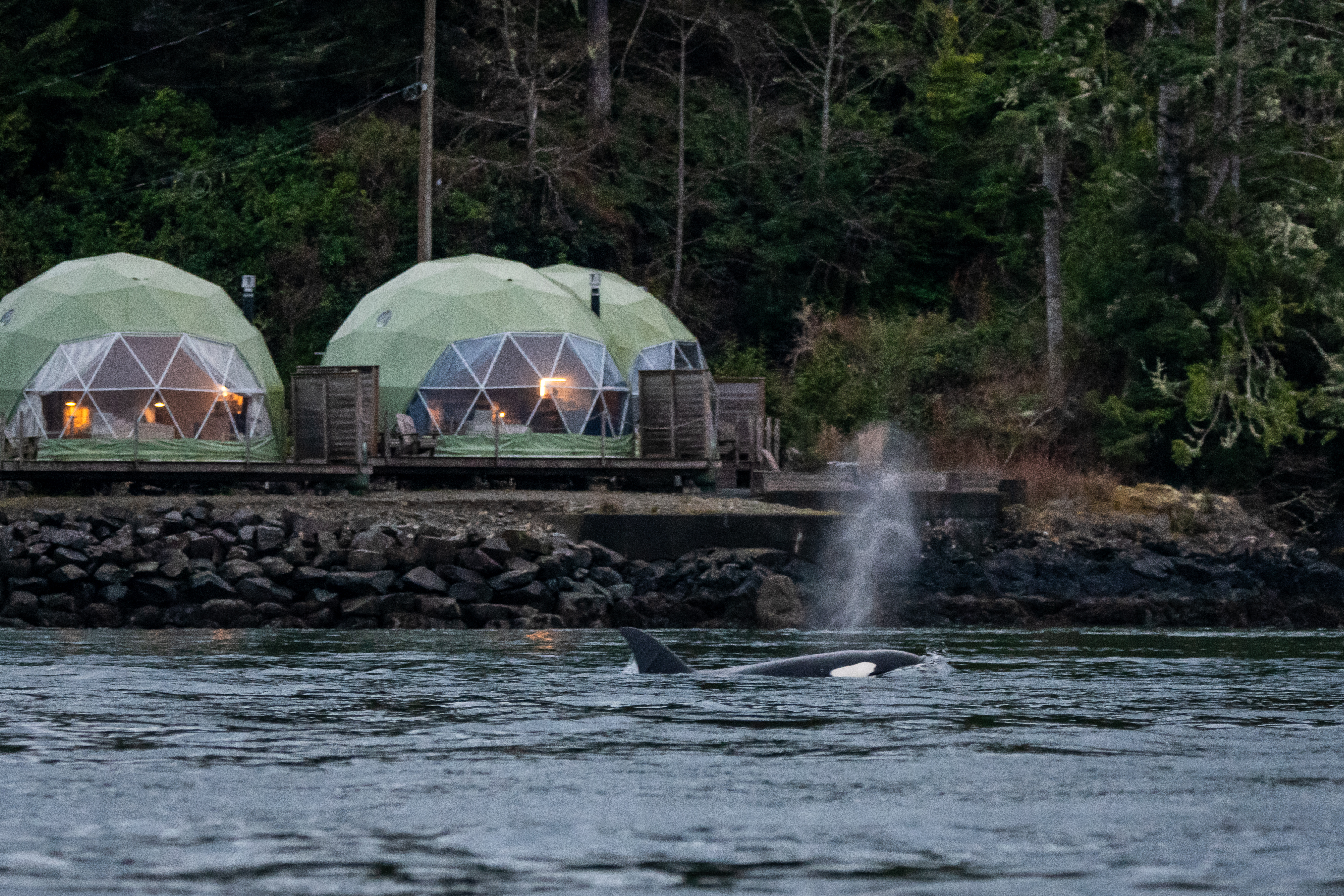
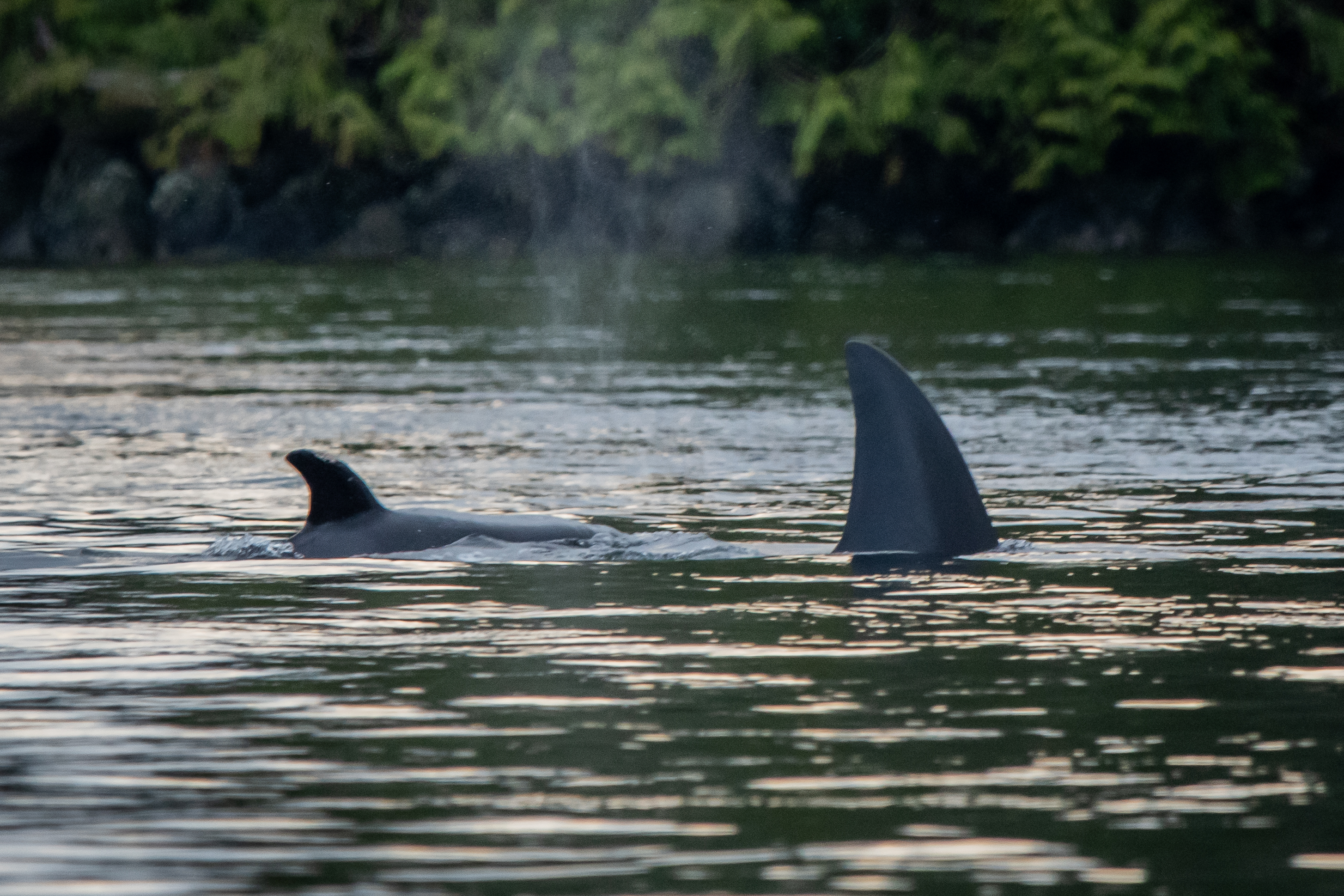
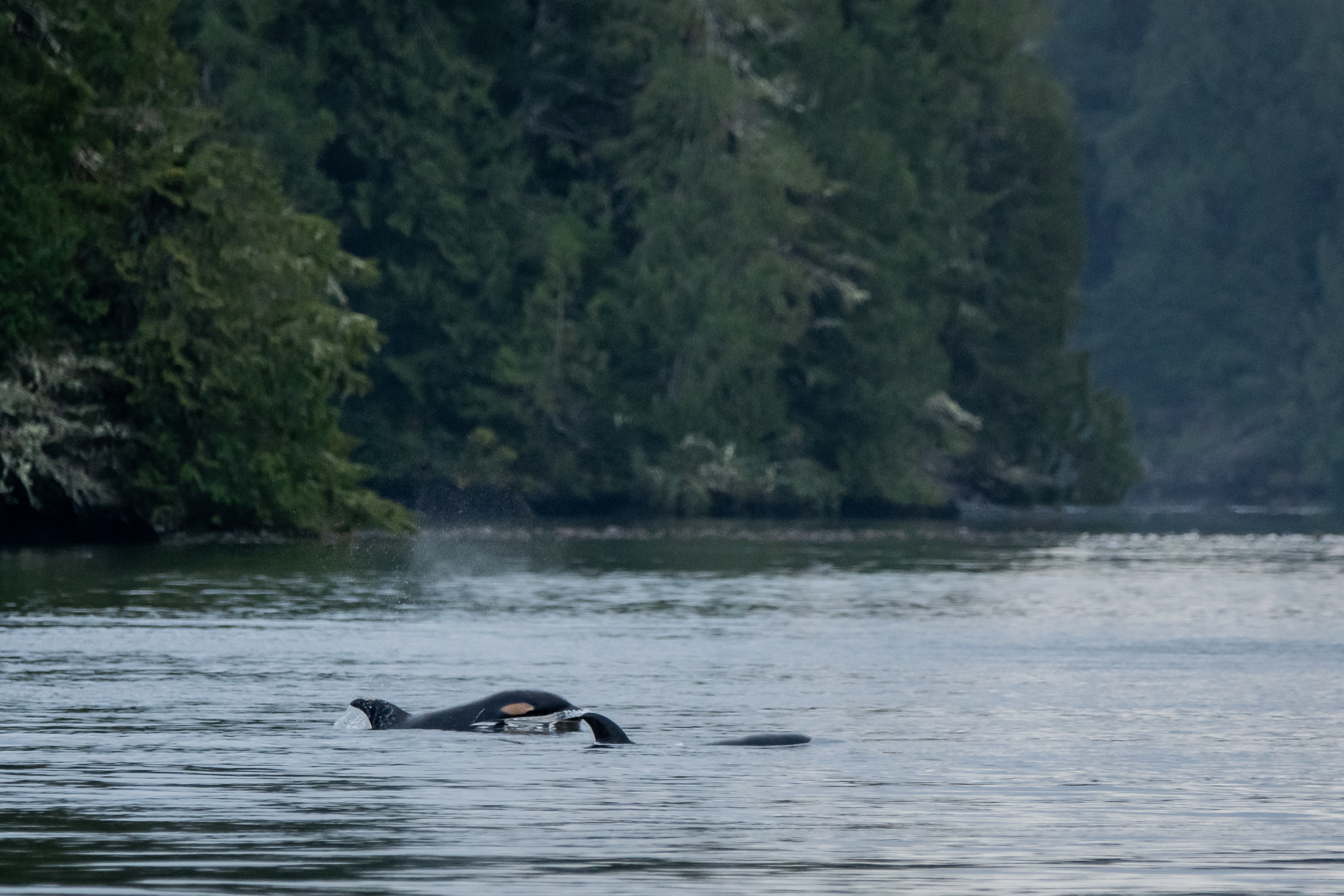
A baby Bigg’s (Transient) orca photographed travelling with T068C pod near Tonquin Beach off Tofino on Jan. 5 appears to be in poor health and will likely die, according to whale researcher and Executive Director of Bay Cetology Jared Towers.
He said the little calf is very skinny, very young and has an open wound on its dorsal fin.
“The thing that is really concerning is, if you look at the head, the head is really pronounced compared to the back. The mom’s back is kind of convex, it’s kind of rounded, compared to the baby’s is kind of concave. It looks like a horse; you could get on top,” Towers explained.
“The calf isn’t nursing very well and not building fat reserves. It’s not far out from dying,” he continued. “It’s nice to see it’s right close to mom though. It looks like mom is trying.”
Towers suspects the wound on the calf’s dorsal fin is probably due to “clan specific aggression” from other killer whales.
The infant mortality rate for Bigg’s killer whales is “really low” compared to Southern Resident Killer Whales, says Towers.
“It’s very common for Residents’ killer whale calves to die within the first few weeks, months or year of life. In this population, Bigg’s killer whales, that’s really quite uncommon. We don’t see a lot of unhealthy babies. We might get one or two a year, but for the most part all the calves that are born end up surviving,” he said.
Bigg’s killer whales, known for primarily hunting harbour seal, harbour porpoise and Steller sea lion, are designated as “threatened” by the Committee on the Status of Endangered Wildlife in Canada (COSEWIC) while Southern residents, which eat primarily Chinook salmon, are listed as “endangered”.
The population of Bigg’s in the coastal subset of Vancouver Island is 385 and remains “steady”, according to the latest report released in Dec. 2025 by Towers and a team of researchers. Towers went on to say the population of Southern residents continues to slowly decline with just over 70 remaining.
Hesquiaht First Nation and Yuułuʔiłʔatḥ next-gen elder Nicki Love shared that orcas, or kakaw̓in as they are called in Nuu-chah-nulth language, are viewed as chiefs returning home.
“kakaw̓in is the keeper of all knowledge,” said Love.
“Each house has its own interpretation of the gift of what nature brings. The more you connect with nature the more you build a house for the soul to live in,” she said. “Long ago, we could speak to all of nature around us. When you are more connected you are more inclined to treat the environment differently. Sadly, our environmental indicators (show) that we are not treating our waters correctly.”
Towers was unsure as to why the baby Bigg’s killer whale is struggling to survive.
“There are so many little mysteries that we just don’t know about,” he said. “We see so little of their lives; even if we are on the water with them all day we are just getting less than five per cent of what they are doing because they spend so much time underwater.”
He went on to say that he is “95 per cent sure” that the calf is the seventh baby of matriarch T068C but is waiting on a second encounter for confirmation as there is a possibility it could belong to another mom.
Finwave photo-identification
Based in Tla-o-qui-aht First Nations territory, naturalist and wildlife photographer Marcie Callewaert received a tip from a local bird watcher that the kakaw̓in were travelling up Tsapee Narrows heading towards Tonquin Beach.
“They stayed fairly active all the way to Tofino with some spy-hops, breaching and tail lobs, which is always exciting to see,” said Callewaert.
She photographed the orcas from the water with a 150 to 600 mm lens, from many different angles, while giving them the space they need to act normally.
Under Canada’s Fisheries Act, people must keep 200 metres away from all killer whales in B.C. and the Pacific Ocean, and under the Shipping Act, people must keep 400 metres away from all killer whales in southern B.C. coastal waters between Campbell River and just north of Ucluelet from June 1 to May 31.
“It’s hard to see details when you are on the water photographing. Every photo from a different angle gives us different information about the animals. It’s so important to capture as many photos as we can,” Callewaert said.
She uploaded the orca photos to finwave.io, an online photo-identification database, which uses AI technology to help predict who the individual whales are – and where they were spotted last.
“For me, Finwave has been revolutionary in my understanding of our Bigg’s population on the coast,” said Callewaert.
In the past, Callewaert, like many other naturalists, would email photos to Towers and other organizations and wait weeks for a reply. Finwave.io, which was launched publicly in 2024, provides a much faster turnaround time for photo-identification.
“We all have our own login and it tracks all of our sightings. I can look at how many individual orcas I’ve seen and I can go to particular orca’s page of data,” said Callewaert.
She shared that pod T068C was last seen in November in Ketchikan, Alaska, prior to her Jan. 5 encounter in Tofino.
While AI makes the initial matches by comparing images of dorsal fins, saddle patches and eye patches, Callewaert says there is a whole team of experts behind Finwave, including Towers, that follows up with confirmation.
“It’s a citizen science approach to data collection,” said Towers. “Anybody with a good camera who knows how to take pictures of orcas can submit to that site and typically within 24-hours they get an email back about who the whales are.”
Callewaert also shared some of her photos of the orca encounter on social media.
“I like to share with our community the beauty of the nature around us. Not everyone gets a chance to get down to the waterfront when they pass through. It’s really neat for people that live in front of the water to have a photo of this megafauna right in front of their house. It’s nice to have that sense of community appreciation for the wildlife we share the area with,” she said.