The logging tenure for a landscape made famous by the “War in the Woods” protests on the west coast of Vancouver Island has been divided up into three new Tree Farm Licenses (TFL) to assert First Nations’ unique land-use visions.
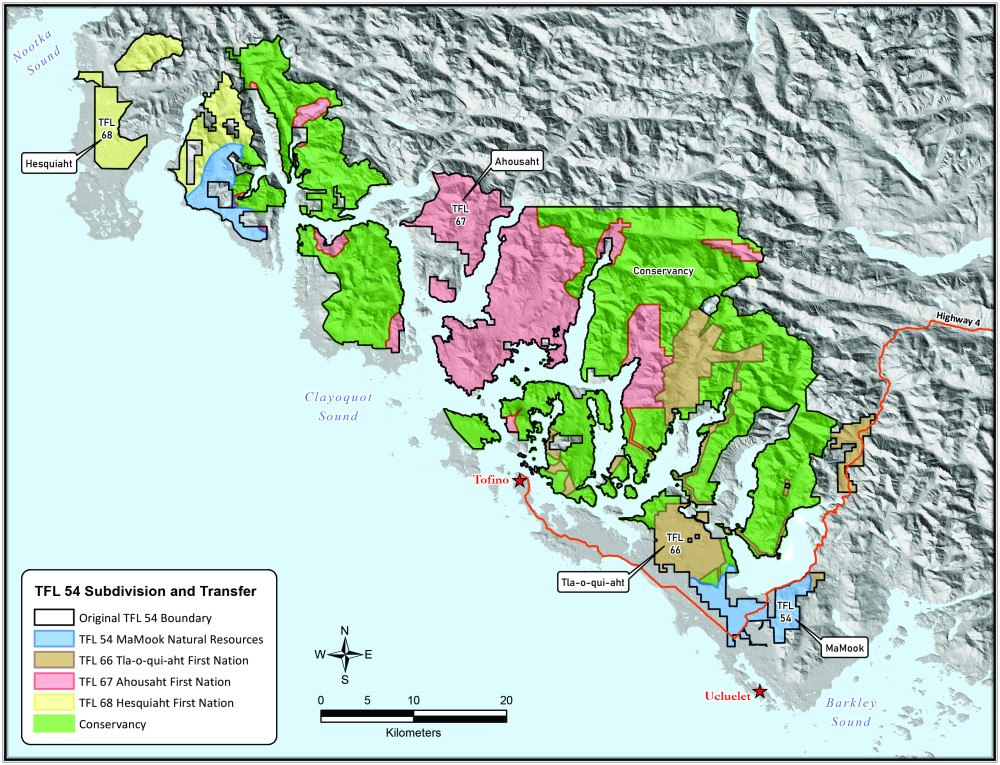
TFL 54 in Clayoquot Sound was transferred from MaMook Natural Resources, which is owned by a partnership of five central region First Nations (Ahousaht, Tla-o-qui-aht, Hesquiaht, Toquaht and Yuułuʔiłʔatḥ), and reconfigured into TFL 66, TFL 67 and TFL 68.
According to the Ministry of Forests, Tla-o-qui-aht is now the holder of TFL 66 comprising over 13,000 hectares within their territory, TFL 67 is held by Ahousaht and comprises over 29,000 hectares in Ahousaht territory and Hesquiaht is now the holder of TFL 68 with an area size of over 9,165 hectares in their territory.
MaMook will continue to exist for the next few years with the legal obligation to clean up old logging infrastructure, including deactivating old logging roads, dryland sorts and log booming areas, but the company will dissolve once that work wraps, according to Toquaht appointed board member Ken Matthews.
The company will also have to ensure all areas previously logged areas are reforested adequately. They anticipate this will take up to three years to complete.
“All First Nation owners of MaMook see this a positive move forward to allow the individual Nations to manage the forests and lands in their traditional territories,” said Matthews.
TFL 54 was transferred from MaMook to the three Nations with compensation provided by Canadian charity Nature United after unanimous MaMook board approval.
“Nature United paid MaMook fair market value for the TFLs, on behalf of the three First Nations,” said Matthews.
“MaMook as a corporation has to pay for all of that deactivation legal clean we have to do and then ultimately whatever is leftover will be split amongst the five (Nations),” he continued.
This milestone for TFL 54 follows a June 2024 landmark agreement with the Province of B.C. and MaMook to remove roughly 77,000 hectares of land from the designated TFL area to be then designated as conservancies under B.C. legislation. These protected areas were primarily in Tla-o-qui-aht and Ahousaht territory.
“Nature United supported this (conservancies) agreement by contributing a one-time allotment of money to Ma-Mook for these areas from the TFL,” said Matthews.
“The BC government agreed to contribute $8 million dollars under a grant to MaMook to be used to partially offset costs of deactivating roads and other logging disturbance in the new conservancies and in TFL 54. This money had to be used for only those purposes,” he added.
Michael Reid is Nature United’s B.C. program director. He lives in Tofino.
“Nature United has raised and contributed more than $40 million to support the creation of new conservation and new forest management areas in the region as well as supporting new stewardship endowments,” said Reid.
About 20 non-profits, organizations and individuals contributed financial gifts to Nature United, or Nature United’s global affiliate The Nature Conservancy, to help reshape Clayoquot Sound’s forest management future, including billionaire Amazon founder Jeff Bezo’s, Bezos Earth Fund and Swiss billionaire Hansjörg Wyss’ the Wyss Foundation.
Lines on a map
Matthews said it took Ahousaht, Hesquiaht and Tla-o-qui-aht leaders four years to agree on the lines on the map that would make up the new TFL designations.
He said some of the decisions went “very easily”, but in other discussions, drawing lines on the map was “very difficult”.
Two small portions of TFL 54 still exist because of “historical disagreements”. Stewardson Inlet out by Hot Springs remain unresolved because of overlap between Hesquiaht and Ahousaht territory and an area south of Kennedy Lake that overlaps between Ahousaht and Tla-o-qui-aht is still in limbo.
“It’s possible that these last pieces will just go into conservancies,” said Matthews.
Hesquiaht, Ahousaht and Tla-o-qui-aht leadership have all indicated a desire to create long-term, sustainable forest management plans for their territories that will ensure the prosperity of future generations.
“Throughout history governments and business have done everything in their power to limit our authority and jurisdiction over what is rightfully ours. Taking management back over a portion of our territory that we’ve managed for thousands of years is a step in the right direction,” said Hesquiaht First Nations Chief Councillor Mariah Charleson in a media release issued by Nature United.
All three Nations have shown an interest in pursuing carbon finance or carbon offsets, according to Reid. Carbon offsetting is when companies, governments or individuals compensate for emissions by taking part in activities that reduce the equivalent amount of carbon dioxide in the atmosphere.
“There are challenges within the existing tenure regime, but I am optimistic they will be able to work through with the province,” said Reid.
“(Carbon offsetting) was part of the conversation 10 years ago. It remains central to the broader conservation economy. Beyond carbon, it’s how can you do more with less and how can you realize the value that these forests provide beyond just the timber values,” he continued.
MaMook Natural Resources Ltd. was an amalgamation of Iisaak Forest Resources Ltd., previously TFL 57 obtained by Iisaak from MacMillan Bloedel/ Weyerhaeuser in 1999 and TFL 54 obtained by MaMook Natural Resources Ltd in a sale from Interfor in 2007.
According to the Ministry of Forests, TFL 66, 67 and 68 began on Jan. 12, 2026 and expire on May 31, 2047.