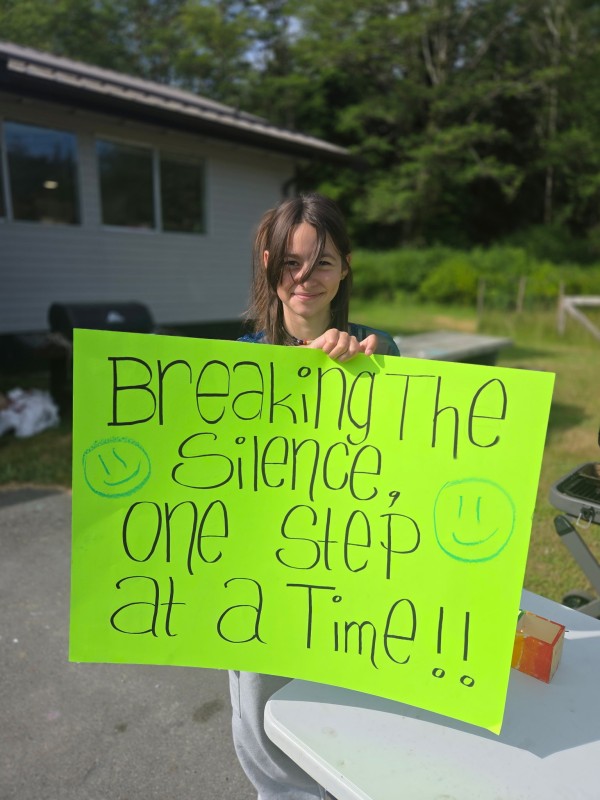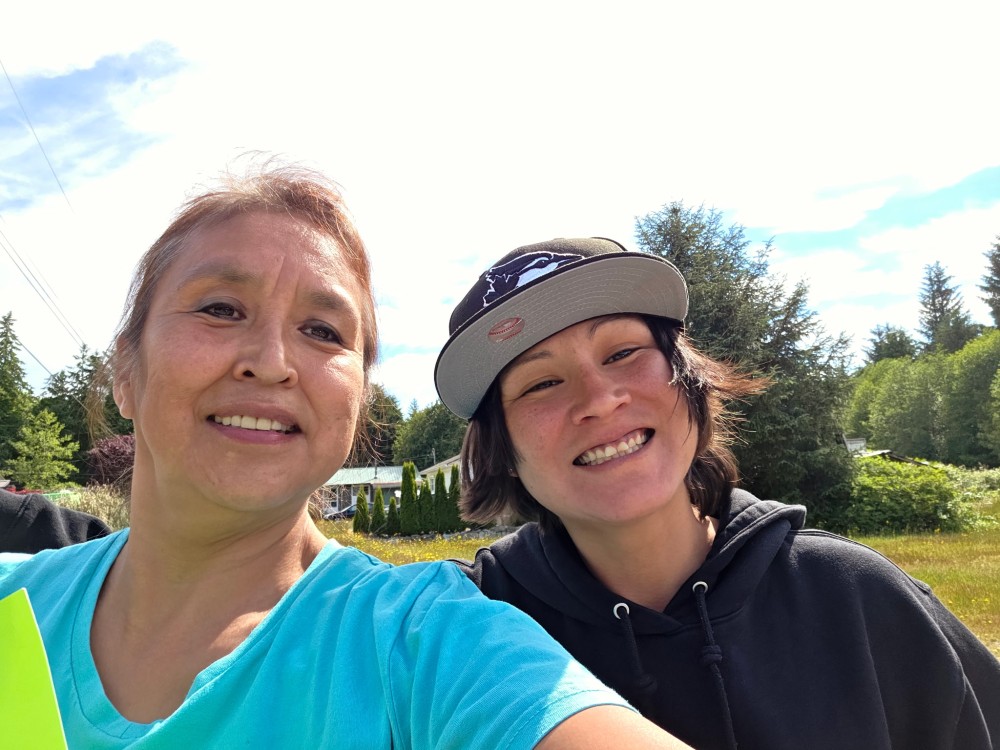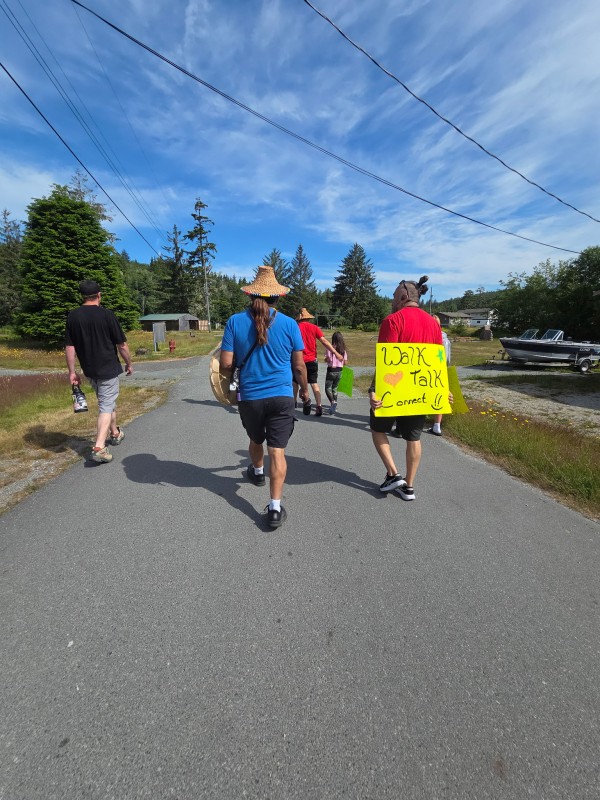
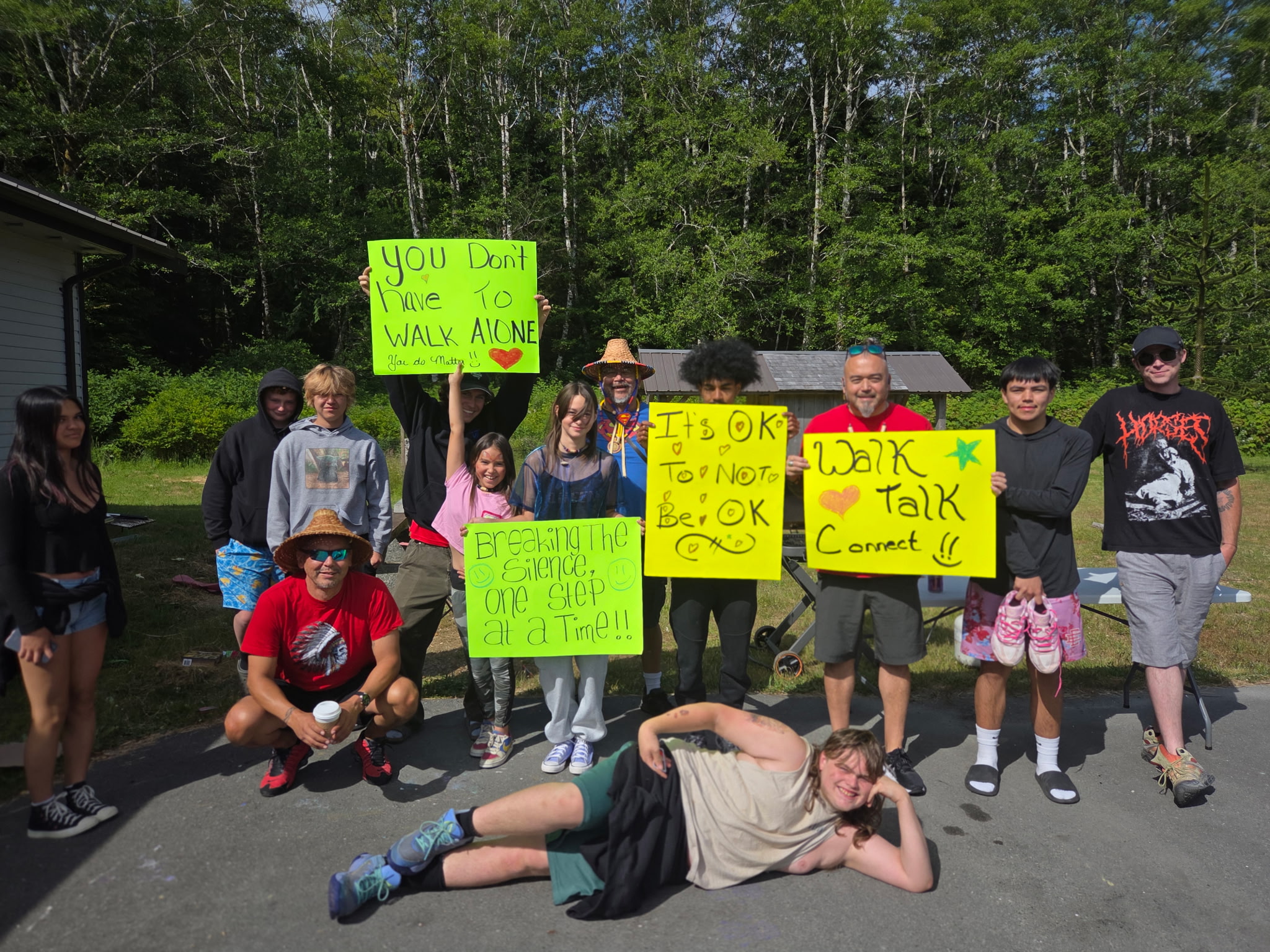
In mid June more than a dozen young people recently took part in a summer walk to raise awareness about men’s mental health and the lack of resources available for them. Organized by Huu-ay-aht mom Jacquie Dennis, the walk, for her, was about finding ways to support men who are in addictions and struggling to make a clean break.
Dennis shared her stories with Ha-Shilth-Sa back in 2022. She spoke of her own journey to sobriety and what she does to help her children, and others, break the cycle of addiction.
In 2022 Dennis brought her son from the streets of Port Alberni to her Anacla home. He was hooked on heroin and needed medical support to get through withdrawals. Not able to get an appointment with the doctor for more than a month, Dennis improvised and, through unconventional methods, found the methadone he needed to safely withdraw.
Methadone is a long-acting drug used in Opioid Agonist Treatment to treat opioid dependence. It is an opioid but, when used as a maintenance treatment, allows the patient to get through withdrawal without pain and with less cravings.
But getting to sobriety is one thing. Staying there is another story.
Dennis says that her son has relapsed many times. And each time he heads back to Port Alberni and when in contact with that old, familiar crowd, he is drawn back in. Each time Dennis will drive from her Anacla home to Port Alberni to bring him home, hoping that he will be done with the streets.
The DUDES Club is a community-based health promotion program largely for Indigenous men in the Downtown Eastside neighbourhood of Vancouver. They have done the research, and their work is focused on building solidarity and brotherhood among vulnerable men.
According to DUDES Club research, Indigenous peoples in Canada continue to experience considerably higher rates of mortality, morbidity, and preventable diseases, with a disproportionate burden of mental health issues, compared to the general population.
“Further, men are generally less likely than women are to seek help with health issues and they face many barriers when accessing mental health services,” stated the group.
This is evident in the ongoing opioid crisis, which has claimed the lives of thousands of men since it was declared a public health emergency in B.C. 10 years ago. According to the BC Coroners Service, over the first four months of 2026 men accounted for 76 per cent of suspected deaths due to drug poisoning.
Men are also at a higher risk of harms from alcoholism, according to a report released this spring from B.C.’s Office of the Provincial Health Officer. Bonnie Henry’s report cited 2023 numbers, showing that men in B.C. were hospitalized due to alcohol-related issues at a rate of 47 per 100,000, compared to the female rate of 31.
The Nuu-chah-nulth Tribal Council’s Teechuktl mental health programs offer support to Indigenous people through their Redford Street offices in Port Alberni. Hector Little is a Quu’asa wellness support worker with the department who knows there’s a lack of resources for men seeking to escape addiction.
Little said he’s had conversations with brothers working hard to take care of themselves in sobriety.
“The hardest part is habitual need to use when emotions are hard to deal with. When things get tough it’s hard to stay away from (substances)…when everything is good for a little while,” he said.
Little believes that, in many cases, things like alcohol are woven into the fabric of a person’s life story.
“In my personal opinion, growing up in it (alcohol abuse), being a part of it, seeing leadership doing it, celebrations, always alcohol involved. It’s a challenge for them to let go of it…it’s like how I belong to the community without alcohol, so letting it go is a tough one,” he shared.
Little says he reminds clients that quitting alcohol is going to be painful and it’s going to be hard.
“Those old habits are gonna tap you on the shoulder a hundred times a day,” he said.
This is why it is important to have things like a peer support and group support that can help men learn how to support themselves.
“You need to replace that with another activity…like physical activity, mental activity,” Little said.
Workers at Quu’asa are developing supports at their Redford Street office.
“We have a men’s group at Redford Street every Friday night. We get guys together, share a meal, let them know they’re safe here,” said Little.
Little says it is important to provide safe, supportive places for men to help them maintain sobriety. The talking circle starts off with drumming, allowing the men to partake in some cultural teachings.
“The talking circle is safe place for them to be heard, and support one another,” said Little.
Others find that support through regular AA meetings held at the NTC health centre on Roger Street.
“I like to talk about the ‘future forecast’,” noted Little about the prospective life without alcohol and drugs. “I ask them, what would your future look like if you gave up?”
Dennis’ five-kilometre walk to raise awareness about men’s mental health issues was a success. On June 23, about 17 youth and other community members walked carrying placards, ending with a free barbecue. She hopes to arrange a similar walk in 2027 for Port Alberni.
Dennis vows to continue to do whatever it takes to help her son, no matter how many times she brings him back home.
Little says showing compassion and consistency is important.
“The first pitch may not land, but if you keep pitching, one is going land,” said Little.
If you are seeking help with addictions or mental health issues, you may reach out to the Mental Health Support Line: Call 310-6789 (do not add 604, 778 or 250 before the number). This number will connect you to your local B.C. crisis line without a wait or busy signal, 24 hours a day.
Crisis line workers are trained to help provide emotional support as well as mental health information and resources.
Crisis Text Service (Vancouver Island): Call 250-800-3806 from your mobile. Available from 6 p.m. to 10 p.m. Pacific Time, seven days a week. If you have unlimited coverage for SMS text messages with your mobile service provider, the texting service will be free of charge.
In Port Alberni and neighbouring communities, you can call the NTC Quu’asa workers at 250-724-3939 and ask for Cherie Elliot or Hector Little, Lee Lucas, or Brianna Rai.