
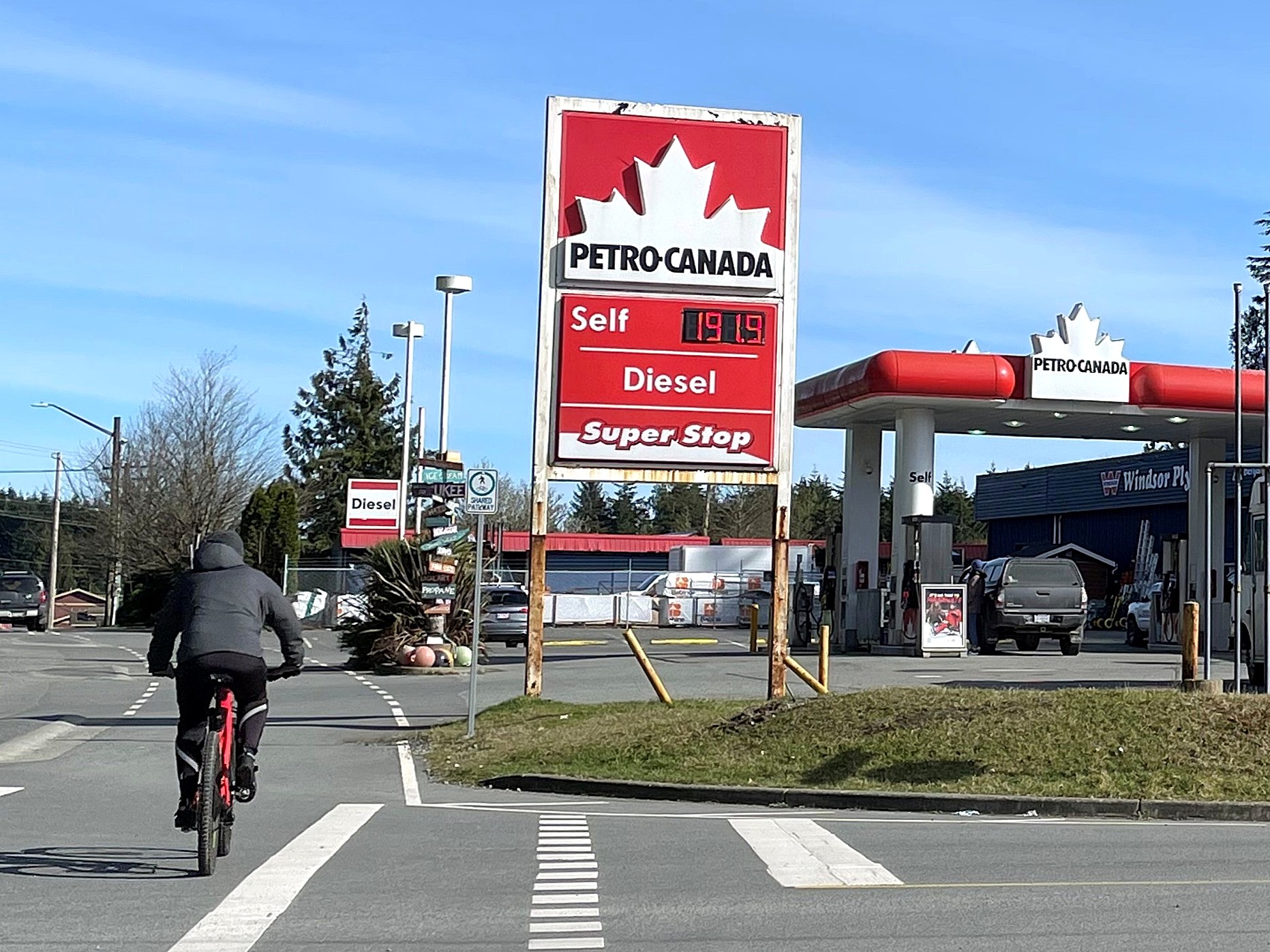
As the west coast kicked off its annual Pacific Rim Whale Festival this month, the price of regular gas went up to $197.9 per litre at Tofino and Ucluelet pumps while images of oil tankers ablaze in the Persian Gulf circulated in international news.
The Strait of Hormuz, a key shipping route for nearly a fifth of the world’s oil supply, is in paralysis due to an ongoing war between Iran and U.S. and Israel, now entering its third week.
“The reduction in global supply causes prices to go up,” said Kathryn Harrison, a political science professor at the University of British Columbia specializing in environmental and climate change policy.
“There is an actual chokepoint there. It’s the only way out and it’s a pretty vulnerable chokepoint along that path that they all have to go through,” she said.
Countries that use the Strait of Hormuz as their primary export route for oil include: Saudi Arabia, the United Arab Emirates, Kuwait, Qatar, Iraq, Bahrain and Iran, according to the International Energy Agency (IEA).
Harrison says the length of the conflict in the Middle East is “as unpredictable as Donald Trump.”
“These are not soldiers on those ships. These are not military vessels. These are privately owned tankers with employees that did not sign up for this,” said Harrison.
“The Iranian regime is not a democracy. Its leadership has been working towards nuclear capability. It is a hostile regime. Yes, Donald Trump is unpredictable and seems to be driven by oil to some large degree, but this is not an allied regime for the world’s democracies either,” she said.
Tofino Chamber of Commerce executive director Graydon Clerk recalled the last time the price of fuel spiked to this degree was when Russia invaded Ukraine in February 2022.
“Tofino is a resilient community and we always make it work,” he said. “We were able to push through and not raise costs. It’s nothing new from their perspective.”
“It’s definitely a risk being a fossil fuel economy,” Clerk continued. “Tofino has made a lot of positive initiatives in the past few years, so when you do get here, you don’t actually need to drive, or you can drive electric.”
Tofino Co-op recently installed several EV charging stations and most of the resorts have charging stations, says Clerk. Folks can also take the free beach shuttle that starts running at the end of June and the West Coast Transit system connects Tofino and Ucluelet with daily trips.
“There are also plenty of bike options as well. I use my own e-bike, it’s easy to get around here. From downtown to Cox Bay, it’s under 20-minutes,” said Clerk.
Brent Baker, general manager of Ahous Adventures, says they are consolidating tours to “maximize efficiencies” as gas prices continue to rise. He said they paid $1.98 per litre for marine fuel last week, which is close to what the Indigenous-owned eco and cultural adventure tour company was paying to gas up vessels when they opened in 2023.
“Our fourth season is off to an amazing start with absolutely incredible sightings so far,” said Baker in an email.
“We appreciate that our guests have been very flexible and open to adjusting some of the departure times allowing us to make smart decisions for the organization such as reducing some of the departures to ensure every boat that departs surpasses its minimum numbers, which enables us to cover our costs while still providing an amazing experience four our guests,” he said.
Harrison said the conflict in the Middle East highlights an underlying trend to shift away from fossil fuels.
“Until we do, the world is just going to keep warming and that is going to be a source of a lot of pain and a lot of instability, in terms of unpredictable weather, wildfires, flooding, but also geopolitical instability,” said Harrison.
But she acknowledged that the upfront costs of purchasing a new electric vehicle or heat pump is a challenge for many Canadian households.
“Someone still has to be able to be able to pay for it in the first place. I think it’s encouraging that the federal government has reinstated incentives for the purchase of EV this year,” she said.
Canadians can benefit from a new federal EV rebate program, which offers incentives for the purchase or lease of an electric vehicle, starting at: up to $5,000 for battery-electric and fuel cell electric vehicles and up to $2,500 for plug-in hybrid vehicles.
For British Columbians, the CleanBC Go Electric Rebates program was paused in May 2025 due to high demand. The government says available funds have been fully allocated and new applications are not being accepted.
Developments in marine vessel electrification is also happening right on the west coast in Ucluelet First Nations traditional territory. Rising Tide Boatworks recently purchased the historic Second World War Royal Canadian Air Force hangar and is building critical infrastructure for boat electrification.
On March 17, Vancouver’s average price for regular gas was 205.3 per litre while Canada’s average was 175.1, according to the daily price survey tracker prepared by Kalibrate Canada.


