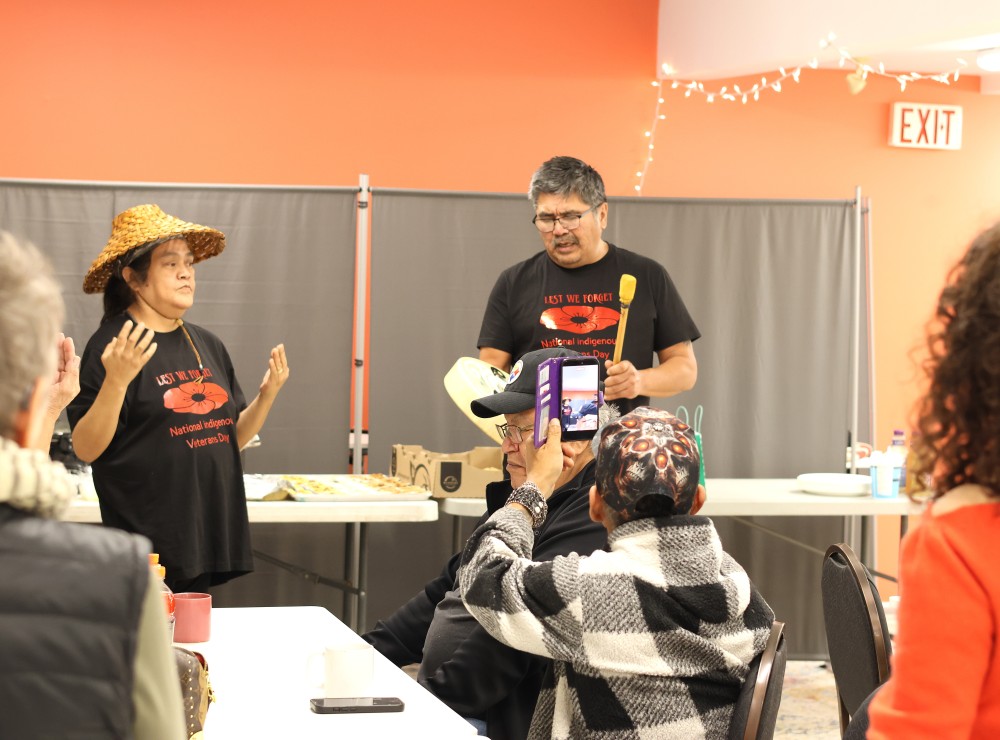
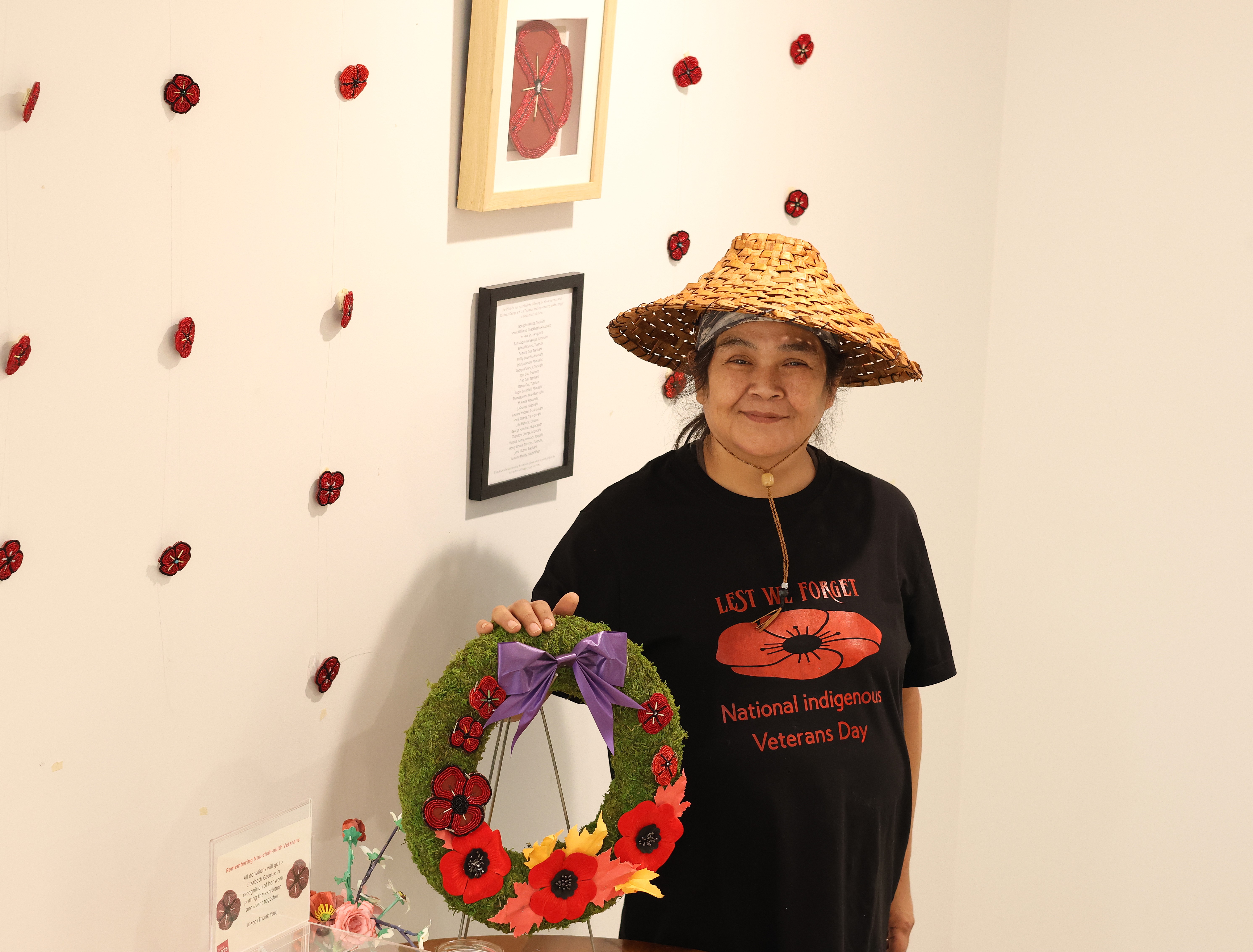
Stories of war veterans passed were shared over a community meal hosted by Nuu-chah-nulth artist Elizabeth George and the Tofino Arts Council (TAC) on November 8, or National Indigenous Veterans Day.
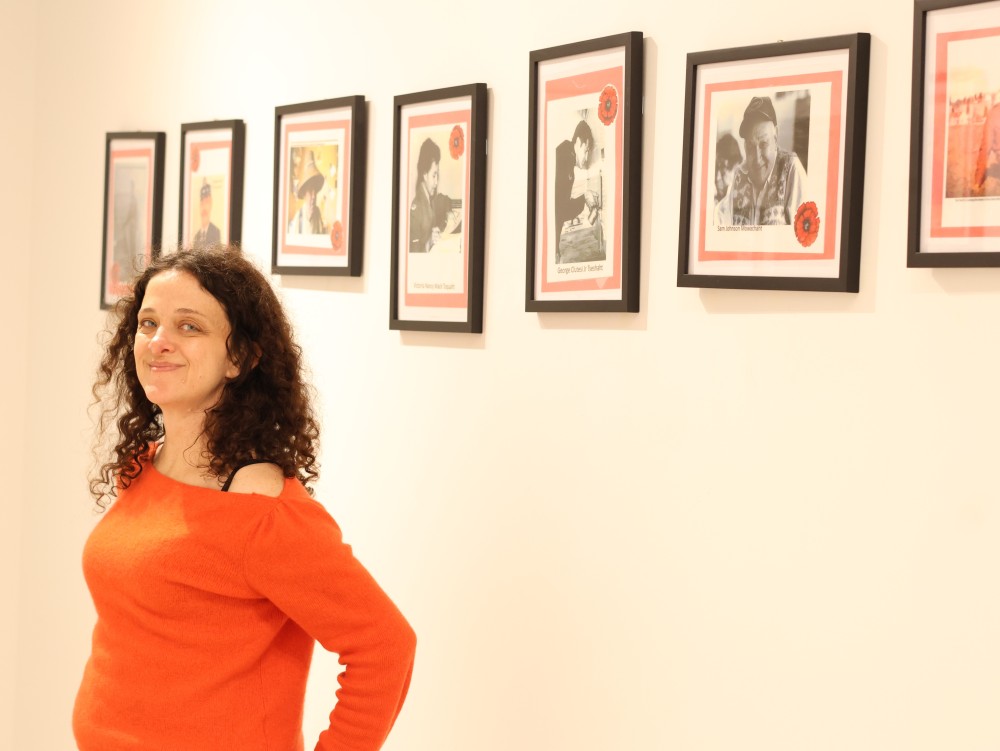
The special gathering took place below the Tofino Legion and also featured a display of beaded poppies alongside a photo exhibit titled ‘Remembering Nuu-chah-nulth Veterans’.
George had two grandpas in the military. Chief Earl Maquinna George left Ahousaht when he was 16 to enlist in the Canadian Army and Reginald “Rusty” Wilson, a member of the Lummi tribe and Cape Mudge Nation, was part of the 101st Screaming Eagles Airborne Division of the U.S. Army.
“We all stand behind my grandpas,” said George.
George’s brother Hayupiinulth (Bill George) said Rusty made headlines when he turned 80 for skydiving.
“It was on his bucket list. It’s the only thing he wanted to do was jump out of a plane,” said Hayupiinulth.
Rusty was born in Campbell River, B.C. on April 26, 1927, and passed away peacefully on Feb. 27, 2015. He was one of 13 children, he was a residential school survivor, and he attended the University of British Columbia.
In 1951 Rusty joined the U.S. Army and served during the Korean War.
The Korean War started on June 25, 1950, when North Korean troops invaded South Korea, according to Veterans Affairs Canada. United Nations forces soon joined the fighting, which would rage until an armistice was signed on July 27, 1953. More than 26,000 Canadians served on land, at sea and in the air during this bitter conflict. Sadly, 516 Canadians died. Long seen as a forgotten war, Veterans Affairs Canada says the Korean War is now recognized as an important chapter in Canada's military history.
In 1998, a cairn was placed on Radar Hill in Pacific Rim National Park Reserve and Tla-o-qui-aht First Nations traditional territory, dedicated to the battle of Kapyong and its importance as a turning point in the Korean War. At the same time, to reinforce Canada’s enduring bond with South Korea, Pacific Rim National Park Reserve was proudly twinned with Hallyo Haesang Sea National Park in Korea.
Code Talkers and Telegraph Lines
George shared that First Nations made great soldiers because they were “good hunters and sharp shooters.”
According to Indigenous Affairs Canada, many of these Indigenous soldiers become successful snipers (military sharpshooters) and reconnaissance scouts (men who stealthily gathered information on enemy positions).
“They would drop the (Indigenous men) behind enemy lines to set a parameter,” said Hayupiinulth.
During the First World War, Indigenous soldiers also took on the role of code talkers, translating sensitive radio messages into Cree so they could not be understood if they were intercepted by the enemy, according to Indigenous Affairs Canada. Another Cree-speaking code talker would then translate the received messages back into English.
U.S. forces used code talkers during World War One and World War Two as well. The U.S. Marine Corps operated the largest code-talking program, according to the National Museum of the American Indian, sending about 420 Navajo language speakers to battle. The 2002 film ‘Windtalkers’ tells the story of a marine who is assigned to protect a Navajo code talker.
“It’s ironic they used (Indigenous) language for coding because they wouldn’t let us use our language,” said George.
Yuułuʔiłʔatḥ (Ucluelet First Nation) members and Hitacu residents Donna and Larry Jack attended the community meal. Hitacu is Yuułuʔiłʔatḥ’s main village located across the inlet from the municipality of Ucluelet.
Donna shared that you can still see old telegraph lines while walking forest trails between Hitacu and the neighbouring territory of Toquaht Nation.
Telegraph lines were built in the early 1900s and were used for relaying news of emergencies. Using wire and electricity, the telegraph worked by turning electrical pulses into dots and dashes that represented letters of the alphabet. This form of communication was called Morse Code.
“The line to Ucluelet ran along Alberni Canal to Uchucklesaht and up to Silver Lake, overland to Effingham Inlet, then overhead across the inlet, overland again to Pipestem Inlet, and along the shore from Toquart to Ucluelet. From there, it carried on along Wreck Bay and Long Beach to Tofino, connecting to Stubbs Island by underwater cable. This Alberni–west coast connection was completed in 1902. By 1914, it extended from Clayoquot all the way to Nootka,” writes historian and author Shirley Martin in her book ‘Calm Harbour, Turbulent Seas: A History of Ucluelet’.
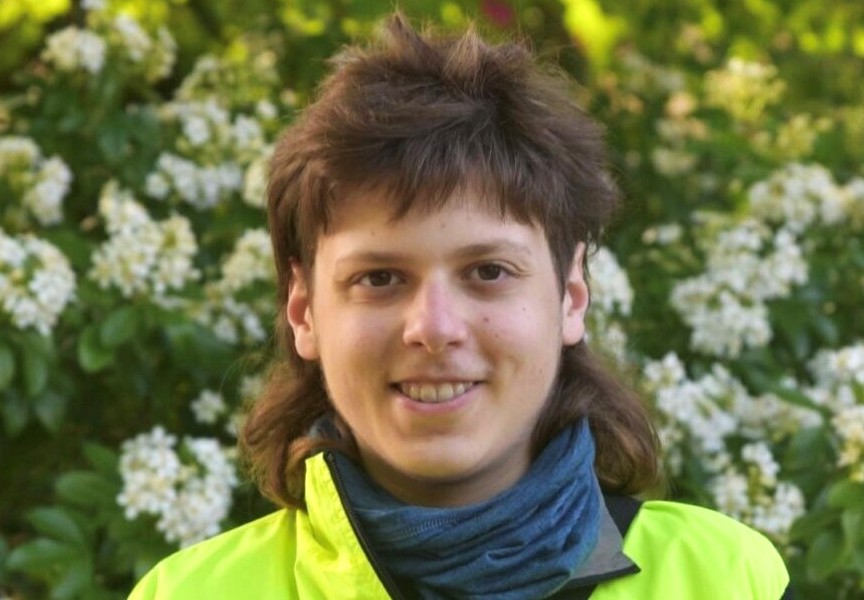
At the end of the community meal, door prizes were awarded and Dredin Amos, 20, won a Patagonia jacket donated by Redd Fish Restoration Society, which he gave to his girlfriend.
When asked about his thoughts on modern-day war and the prospect of fighting for his country, he said: “I would want to defend Canada.”
The ‘Remembering Nuu-chah-nulth Veterans’ photo exhibit is running until Nov. 19. On Nov. 20, the TAC Hallway Gallery will feature artwork by Ucluelet Secondary School students.
Nuu-chah-nulth Veterans
With assistance from Grace George, Darlene Frank and the Ucluelet Secondary School, the Ha-Shilth-Sa has compiled the following list of Nuu-chah-nulth war veterans:
- Douglas David, Tla-o-qui-aht – Served 24 years in the US Navy; Vietnam War Veteran and decorated sailor
- James Swan, Ahousaht
- Jack (John) Watts, Tseshaht
- Frank Williams, Checklesaht/Ahousaht – World War II; Canadian Army
- Tim Paul Sr., Hesquiaht – World War II; Canadian Army
- Earl Maquinna George, Ahousaht – World War II; Canadian Army; former Ahousaht Chief councillor
- Edward Clutesi, Tseshaht – World War II; Canadian Army
- Ramona Gus, Tseshaht
- Phillip Louie Sr, Ahousaht – World War II
- John Jacobson, Ahousaht – World War II; Canadian Army (Infantry)
- George Clutesi Jr, Tseshaht
- Tom Gus, Tseshaht
- Fred Gus, Tseshaht
- Danny Gus, Tseshaht
- Angus Campbell Sr., Ahousaht – World War I & II; Canadian Infantry (BC Regiment),
- Thomas Jones, Nuu-chah-nulth
- M. Amos, Hesquiaht
- J. George, Hesquiaht
- Andrew Webster Sr., Ahousaht
- Francis Harry Charlie, Tla-o-qui-aht – World War II; Royal Canadian Army
- Luke Mahone, Ditidaht
- George Hamilton, Hupacasath
- Theodore George, Ahousaht
- Victoria Nancy Joe-Mack, Toquaht
- Henry Vincent Thomas, Tseshaht,
- Jerid Clutesi, Tseshaht
- Lorraine Mundy, Yuułuʔiłʔatḥ
- Benedict David, Nuu-chah-nulth – Vietnam War
- Victoria Nancy Mack, Toquaht
- Sam Johnson, Mowachaht
If you know of a Nuu-chah-nulth war veteran who is not included in this list, please contact Ha-Shilth-Sa at 250-724-5757.