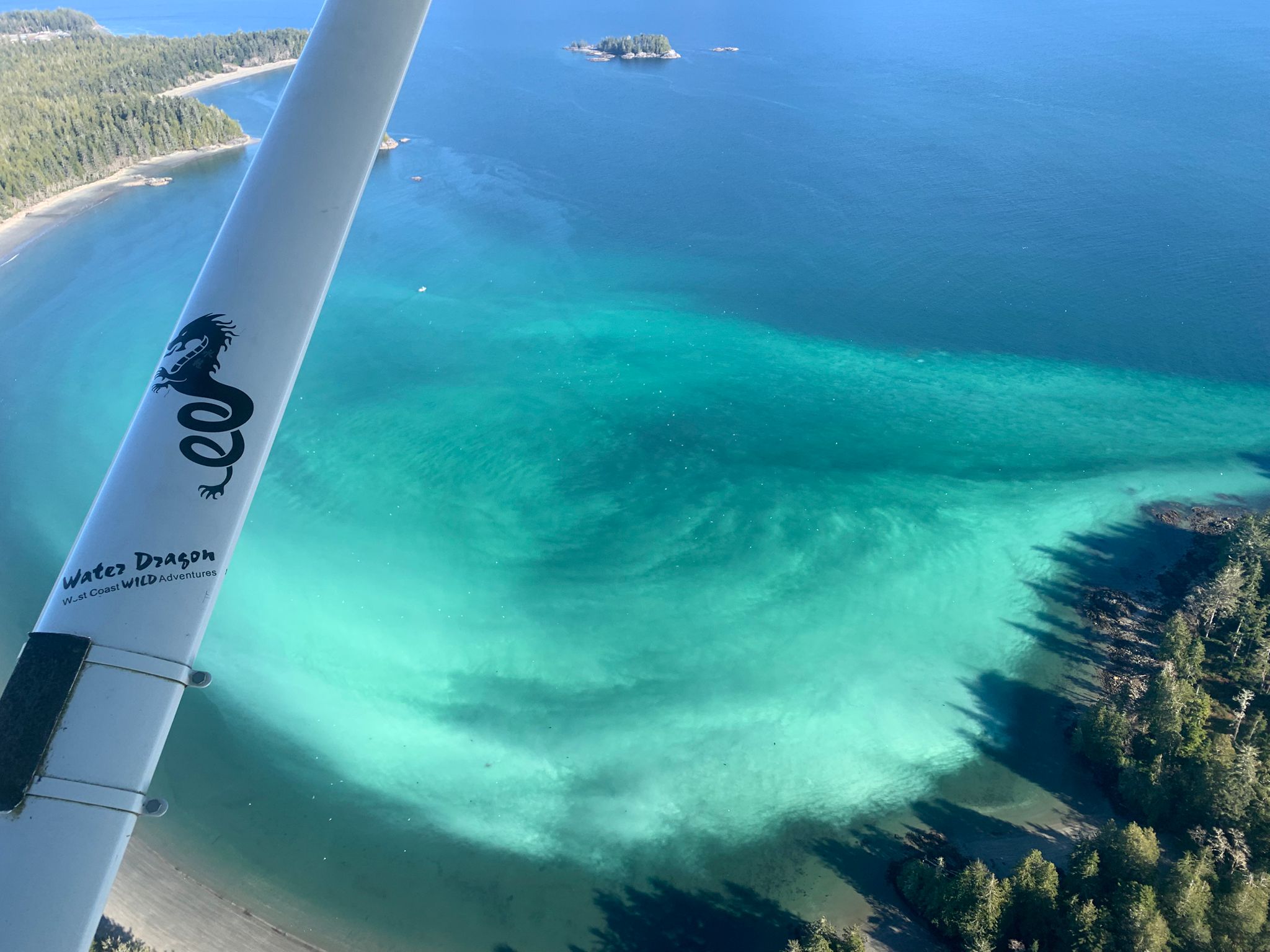
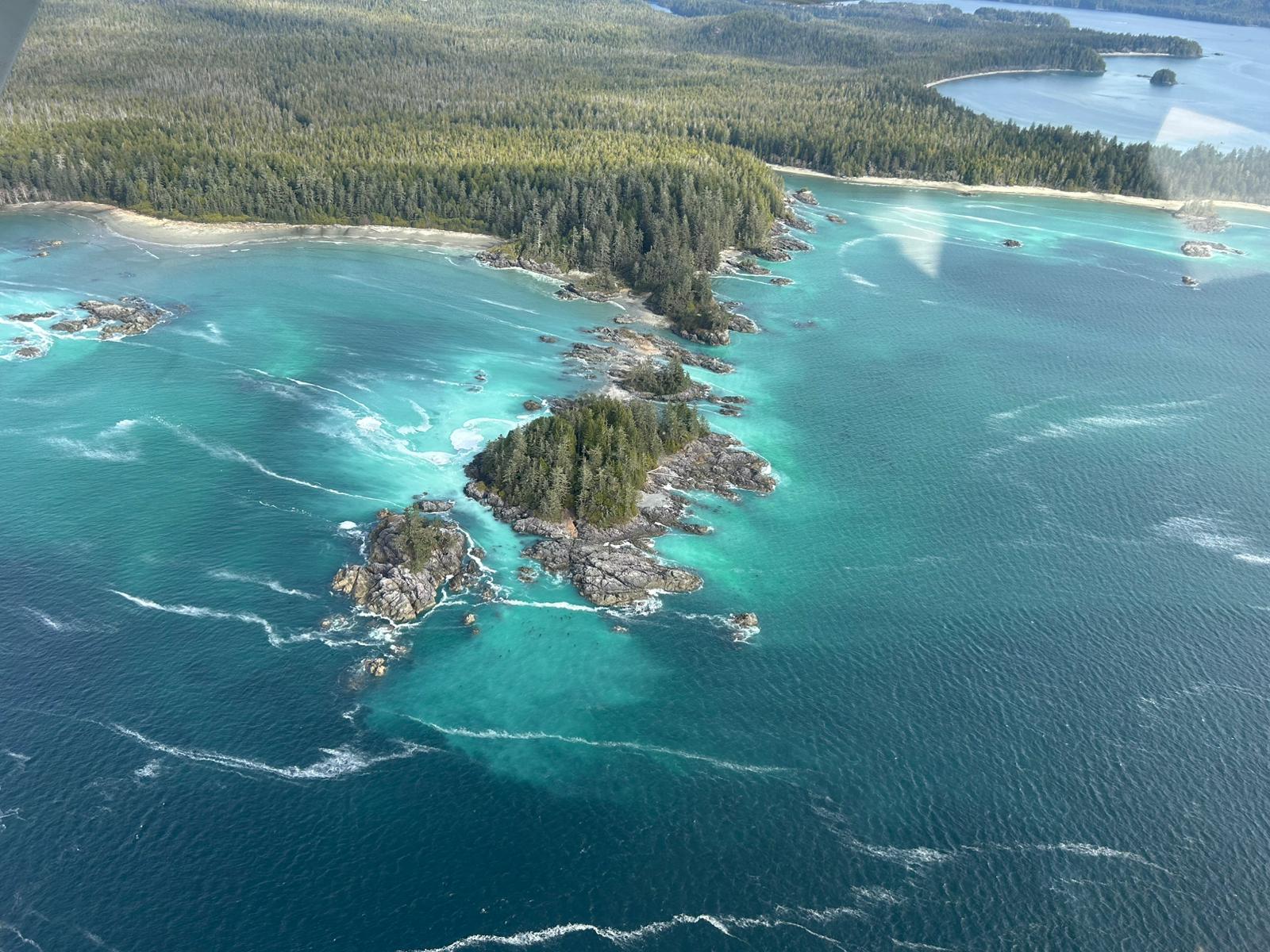
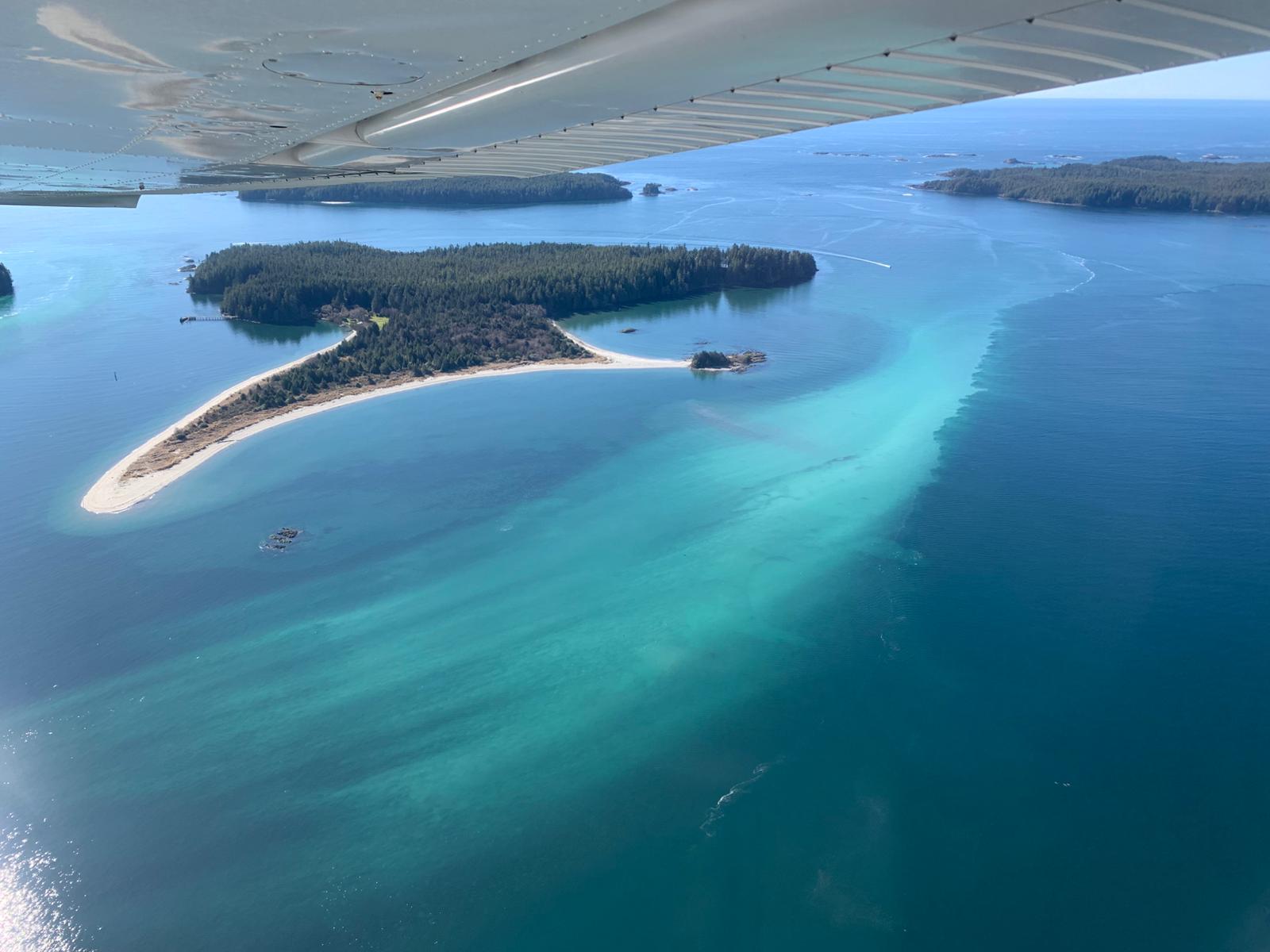
On Monday seagulls could be seen divebombing into the ocean near the base of Catface Mountain, the waters near the shore a milky hue.
The birds were tapping into a current of excitement spreading through Nuu-chah-nulth territory, as herring continue their late-winter tradition. This reproductive activity entails each female laying thousands of eggs that stick to underwater rocks, silt and kelp, awaiting the milky spawn from male herring that turn portions of the Pacific into a lighter aquamarine blue.
Confirmed herring spawn on the west coast of Vancouver Island was first sighted by the Island Marine Aquatic Working Group in mid February. On Feb. 16 satellite images showed spawn at Hesquiaht Harbour, followed by sightings south on the coast near Ucluelet between Mussel Beach and Maggie River Feb. 19, while the milky water was also detected by Brady’s Beach in Bamfield on the same day.
Reproductive activity from the keystone species continued in late February. Tla-o-qui-aht Fisheries Manager Andrew Jackson joined staff from Fisheries and Oceans Canada for a flight on Feb. 27 to spot spawn in several parts of the Island’s west coast, including on the northwest coast of Nootka Island in Nuchatlaht territory.
“We saw dissipated spawn on the outside of Nuchatlitz, estimated to be four to six hours old, we saw new spawn (active) North of Nuchatlitz and southeast of Katala Island,” reported Jackson. “These spawns were relatively small in nature. We also observed approximately 30 whales in the area.”
Spawn was also seen in Tla-o-qui-aht territory around Stubbs and Wickaninnish Islands near Tofino.
“All the spawns we observed were small in nature but was good to see them back in our nation’s territory,” said Jackson.
The spawn enabled Nuchatlaht to continue their annual collection of herring roe, distributing to members.
“We had one last week for about three days in our area,” said Judae Smith of Nuchatlaht’s fisheries department.
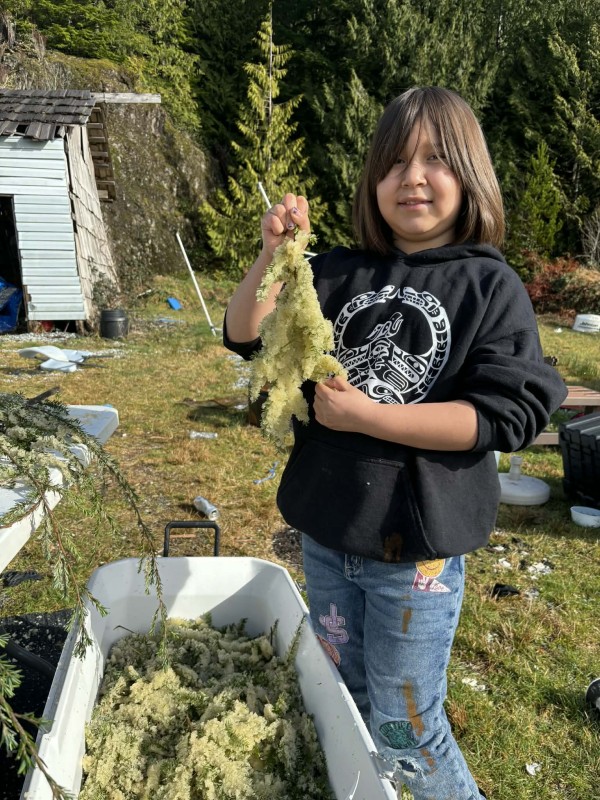
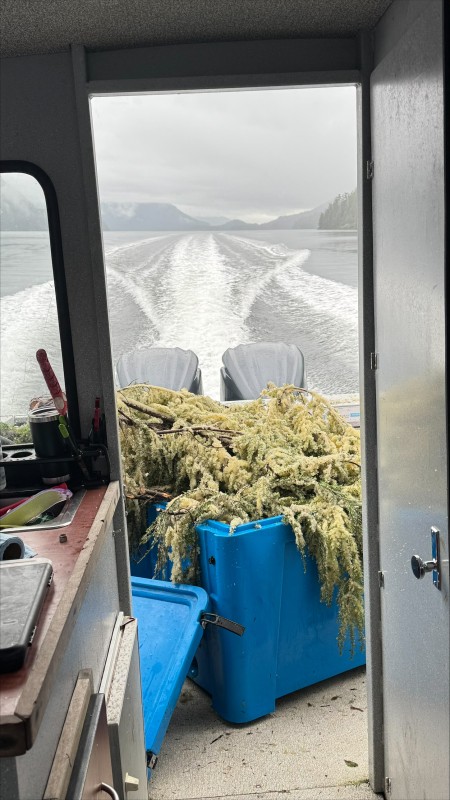
The First Nation soaked 12 trees for two to three days, collecting the beloved k̓ʷaqmis when the branches became thick with herring eggs.
“We harvested a couple of half totes on the trees,” added Smith, noting that they gathered so much k̓ʷaqmis that the Nuchatlaht were able to share their distribution with the neighbouring Ehattesaht and Ka:'yu:'k't'h'/Che:k'tles7et'h' First Nations.
After a period of meagre herring stocks, recent years have brought encouraging signs on the west coast of Vancouver Island. The region’s biomass, which is an assessment model used to calculate the collective weight of the fish, was under 15,000 tonnes in 2018, but this rose to as high as 65,500 tonnes in 2024, followed by 62,160 last year and 55,432 tonnes expected for 2026.
Reproductive modelling has shown an even more marked rebound, according to the herring spawn index, which is the sum of various data collected to measure spawning. In 2015 the spawn index was under 12,000 tonnes, but this rose to over 86,300 tonnes in 2024 – the highest index tracked on the west coast of Vancouver Island since the mid 1970s, a time when the species was challenged by extensive commercial fisheries. Last year the spawn index was 59,800 tonnes, while 47,525 is forecast for 2026.
The region has not sustained a commercial herring fishery since 2005, which was followed by years of the biomass wallowing under 10,000 tonnes. Seign and gillnet fleets are still not permitted off the Island’s west coast, but in 2025 a limited commercial row on kelp harvest began, with an initiative by the Ha’oom Fisheries Society. The commercial roe on kelp harvest continues this year, which opened Feb. 27.