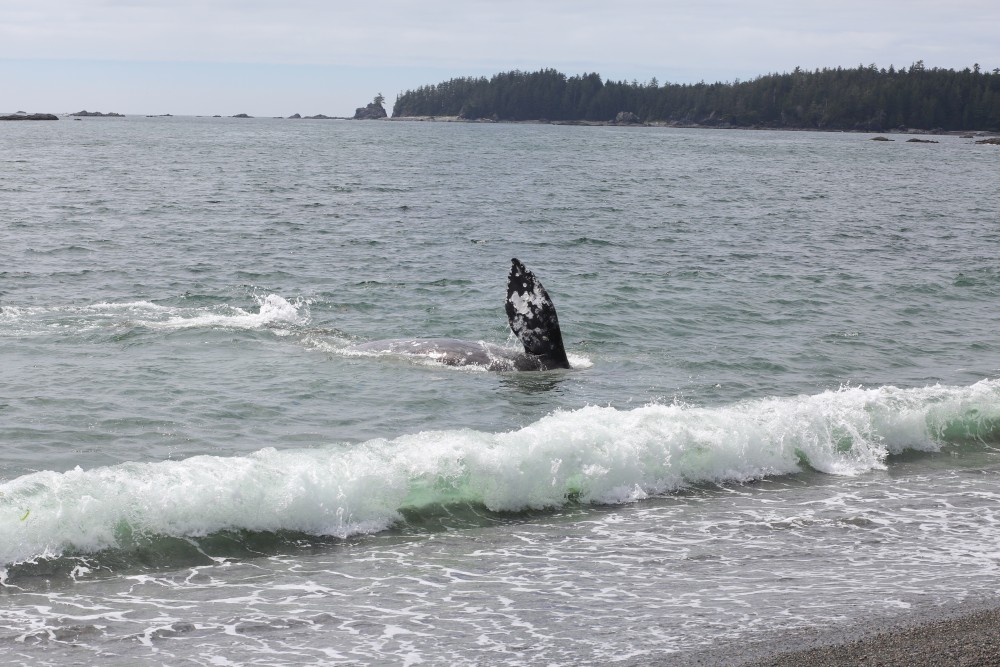
A new study on the diet of grey whales as they forage on the coast of Clayoquot Sound is indicating that the animals are making the long migration from Mexico on empty stomachs.
The investigation is underway in the traditional territories (hahulthi) of Ahousaht. Ocean Wise Whales Initiative researchers say they are conducting research under the informed consent of Ahousaht Ha’wiih to learn what the local grey whale populations are feeding on as they migrate through the First Nation’s territory.
Hanna Meyer is a biologist with Maaqutusiis Hahoulthee Stewardship Society.
“Ahousaht was historically a whaling nation, and so the project holds cultural relevance for Ahousaht musčim (people),” Meyer stated.
Meyer told Ha-Shilth-Sa that grey whales are listed as a Species of Special Concern under the Committee on the Status of Endangered Wildlife in Canada, and that the Pacific Coast Feeding Group (PCFG), the sub-population which spends much of its foraging season in Clayoquot Sound, is now listed as endangered.
She went on to say that not a lot is known yet about the Pacific Coast Feeding Group.
“The project poses an opportunity to deepen the understanding of the individual grey whales that return to feed in Clayoquot Sound year after year, and to uncover historic and emerging patterns to when and where feeding sources are available,” said Meyer.
There are an estimated 60 grey whales from the Pacific Coast Feeding Group found within Ahousaht territory, according to researcher Dr. Chloe Robinson. Ahousaht Guardians have noticed areas that the whales frequent in search of food.
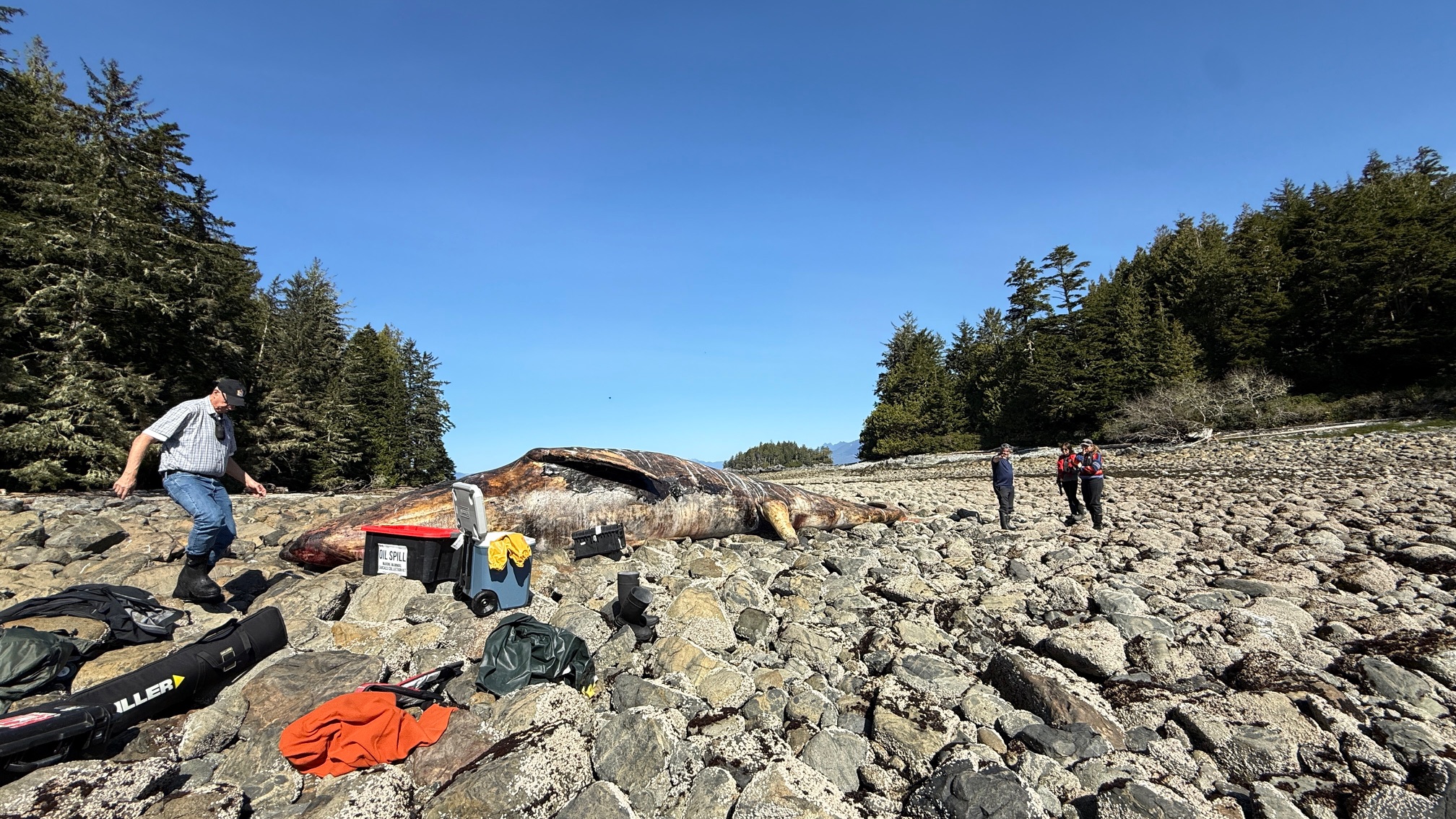
In April 2026, Ha-Shilth-Sa reported that 30 dead grey whales had washed up on the coast of North America that spring. By mid-July the number had climbed to 145 on coastal North America, according to the National Oceanic and Atmospheric Administration (NOAA).
In 2016 an estimated 27,000 eastern grey whales migrated from the Arctic to Baja California in Mexico. In 2025 that number dropped to 13,000, said Dr. Chloe Robinson. For every dead whale that washes up on beach, there are far more lost in the vast ocean.
“What’s being found, multiply that by hundreds is probably the number of dead whales in the deep ocean,” said Robinson.
Grey whales have special plates in their mouths called baleen that allow them to strain out sea water, screening in tiny marine life like krill, small schooling fish, and zooplankton by filtering them out of ocean water. They need about 1,100 to 1,300 kilograms of food daily.
The dead grey whales found along Vancouver Island in the spring of 2026 were believed to have died either by vessel strikes or malnutrition, according to Paul Cottrell, marine mammal coordinator with Fisheries and Oceans Canada.
“They were very skinny animals, a bag of bones,” he said.
Robinson leads the Ocean Wise Whales Initiative. Her team has been working with the Ahousaht Guardians and the Maaqutusiis Hahoulthee Stewardship Society to study the whales. She said they received funding in late 2025 for the project. They are cataloging the whales and studying what they are eating.
Robinson said the whales typically feed on invertebrates in the Arctic where they winter. But with climate change and melting glacial ice, it appears the whales are not finding enough to eat.
“Every year they are getting skinnier and skinnier,” she said, noting that in some whale carcasses you could see every bump and indentation of the skull through the skin.
The migration route from the Arctic to the breeding grounds in Baja Mexico is a round trip of up to 16,000 to 22,500 kilometres both ways. They would typically fatten up in the Arctic and migrate south to their breeding grounds.
Then every spring the grey whales migrate north, feeding along the way.
“It’s like a highway stop,” said Robinson.
It seems the whales are migrating south on empty stomachs, and it’s not clear what they are finding to eat along the route.
Another change in grey whale behavior is that they are moving into Victoria and Vancouver harbors in search of food. Heavy with boat traffic and industrial waste, the waters are considered highly polluted.
“They’re starving and foraging in polluted water, it’s like feeding in a dumpster,” said Robinson.
The Ocean Wise Whales Initiative, alongside Ahousaht Guardians, have been collecting seawater immediately after a whale feeds in an effort to determine what they are eating. Robinson says the whales will dive and scoop up mud which they bring to the surface when they’re feeding. Researchers then collect about two litres of sea water which are sent to a lab to be analyzed.
“There is a desperate need to understand what they eat and protect them,” said Robinson.
Working with the Ahousaht Guardians and the MHSS, as well as an NGO called Whales of Clayoquot and Barkley Sounds, researchers have noticed the whales are showing signs of malnutrition, but they don’t yet know what they’re feeding on Clayoquot Sound.
The groups work directly with Ahousaht and MHSS, who have ongoing stewardship projects.
“They were already studying the whales, and (through this project) will get data into the hands of the people that need it,” said Robinson.
The research runs under the informed consent of Ahousaht's hereditary chiefs, who set the terms for what happens in their territory and how results get interpreted, Robinson stated.
Should we be concerned about what is happening to the grey whales?
“Yes, 100 per cent,” said Robinson. “We could lose Grey whales in a lifetime – it’s that kind of scary.”