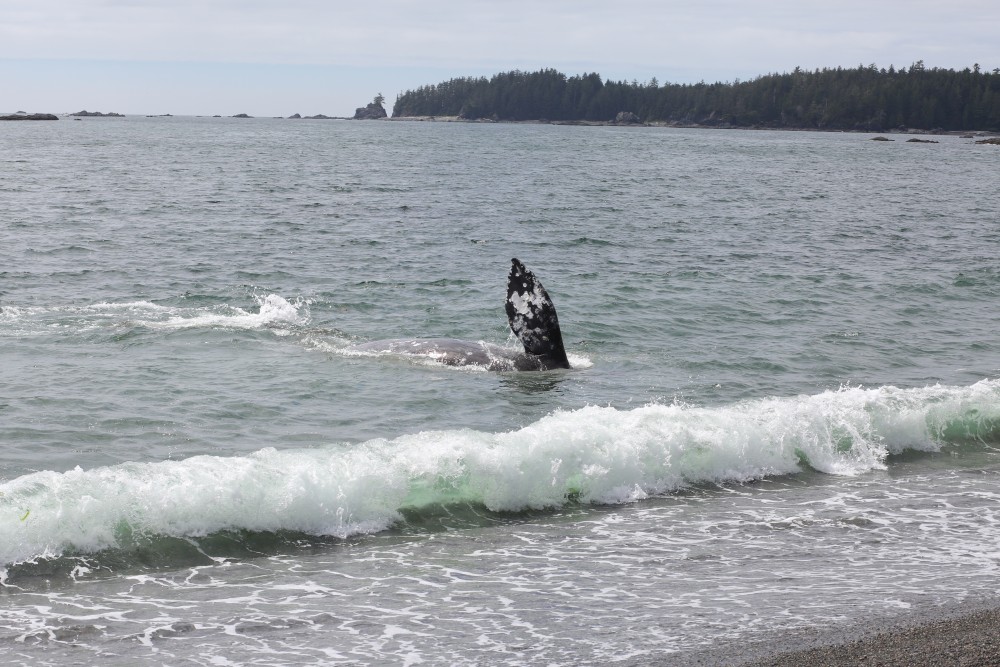
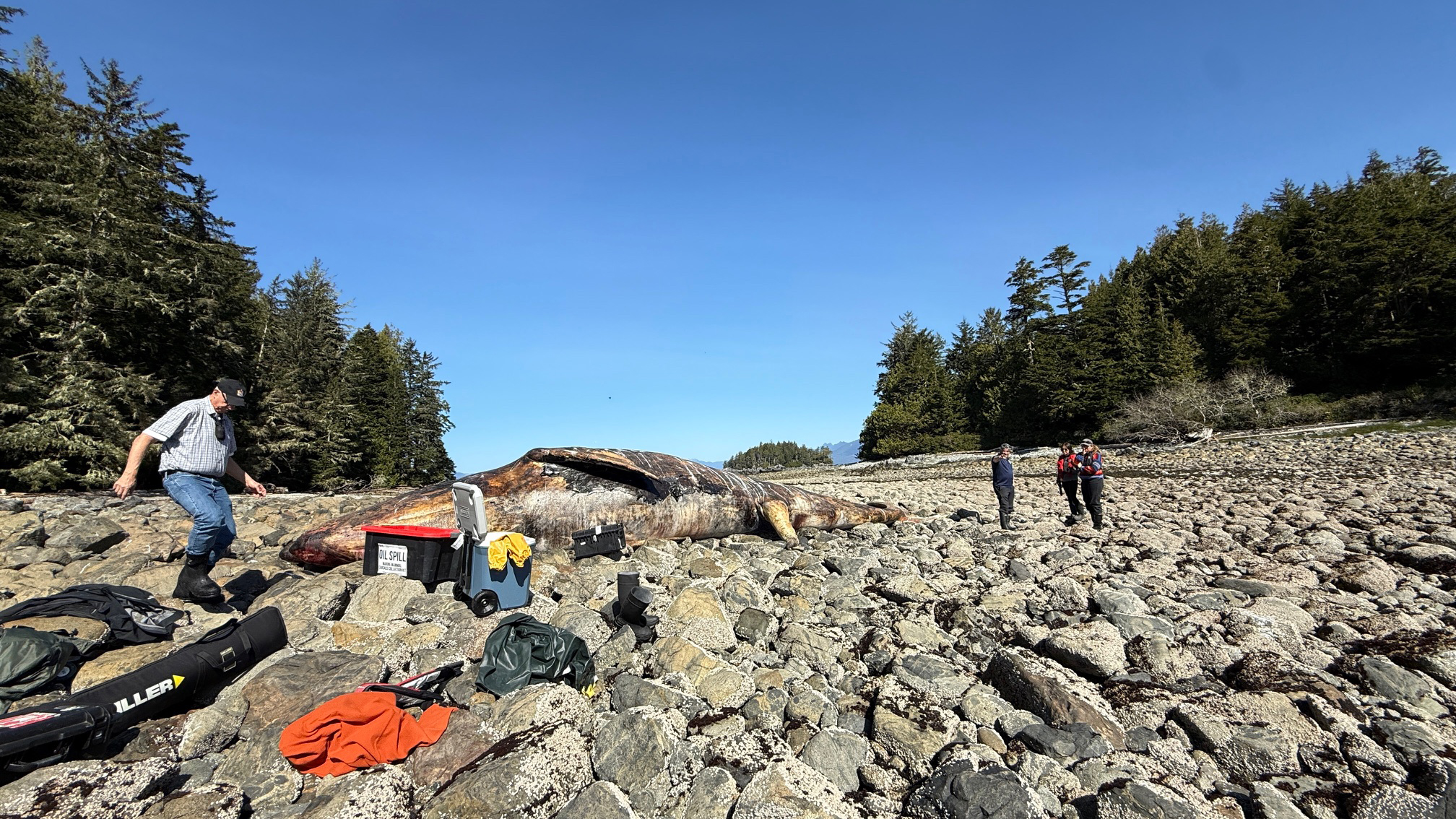
An alarming number of dead grey whales have been found on beaches of the Pacific Northwest. Most of the carcasses show tell-tale signs of starvation.
Reports indicate that 18 dead grey whales were found in the Pacific Northwest region in April – with five in British Columbia and thirteen in neighboring Washington State. Add to that the dead grey whales found in Oregon, California and Mexico in the last few weeks and the number jumps to more than 30 found this spring.
According to Paul Cottrell, a marine mammal coordinator with Fisheries and Oceans Canada (DFO), the whales found around Vancouver Island in April were floating offshore. At least three of the carcasses were towed ashore for necropsies. Two of the dead whales were towed to Nuu-chah-nulth territories, one in Huu-ay-aht territory and the other in Kyuquot.
There were two males and one female found floating in the waters off Vancouver Island.
“They were very skinny animals, a bag of bones,” said Cottrell.
According to Cottrell, researchers believe the grey whales died by vessel strikes or malnutrition. It is believed that the starving whales venture through shipping lanes in search of food.
Grey whales are migratory mammals traveling up to 22,500 kilometres between their summer feeding grounds in the Arctic to their winter calving lagoons in southern California and Mexico. A newborn calf is about 5 metres long and will grow to be up to 15 meters, weighing about 450,000 kilograms when fully grown.
A grey whale needs over a tonne of food daily to survive. They are bottom feeders, stirring up sediment on the ocean floor then straining their catch through their baleen. They feed on benthic invertebrates, mostly amphipods, a flea-like crustacean. They also consume tube worms, crab larvae, mollusks and herring eggs.
At this time of year, the grey whales are making their way back to their summer feeding grounds in the Arctic – the Bering and Chukchi seas. Cottrell noted that conditions were not good for feeding whales in the summer of 2025.
It is believed that climate change is a contributing factor to the lack of food supply for the Eastern North Pacific grey whales. According to the United States’ National Oceanic and Atmospheric Administration, ice coverage in the Arctic is melting earlier in the season and more receding than in previous decades. This could impact prey distribution, quantity and quality. “The impacts of climate change on baleen whales are unknown, but it is considered one of the largest threats facing high latitude regions where many gray whales forage,” NOAA states.
NOAA goes on to say that any resulting changes in prey distribution could affect foraging behavior, nutritional stress, and diminished reproduction for gray whales. Additionally, changing water temperature and currents could impact the timing of environmental cues important for navigation and migration.
Poor nutrition means lower birth rates for the grey whales. There were 84 calves born in the Baja lagoons last winter, the lowest on record to date.
“Nutritional stress lowers the female’s ability to carry a pregnancy and feed the young,” said Wendy Szaniszlo, a marine mammal technician for DFO.
Cottrell says there were 28,000 grey whales in 2019. By 2023 the animal’s population dropped to 14,000. This year the population is estimated to be 14,500 to 11,000 and declining.
“We hope it’s just a blip but it’s probably more than that,” said Cottrell.
DFO is working with scientists from other countries. They are using drones to track the migrating whales, watching for changes in body condition.
Little is known about what the whales are feeding on as they pass through the waters of British Columbia. Szaniszlo says more research is needed.